

On September 3, 2025, during a military parade in Beijing, a hot microphone captured a brief exchange between two world leaders. The remark that traveled fastest was a simple observation that in this century humans may live to 150, and that biotechnology could let people live younger, longer lives. It was an offhand moment about the science of aging, nothing more.
The western internet responded predictably, treating the small talk as if it were a plot. The story ricocheted across every major outlet, positioned not as a serious policy discussion but as clickbait.
Here is what nobody asked: why did this conversation produce such a visceral reaction?
The answer is straightforward. That day was filled with hours of discussion about trade agreements, economic corridors, and bilateral frameworks. Nobody cared. Those discussions produced no headlines or viral clips. The longevity exchange, caught in an unguarded moment, generated more coverage than everything else combined.
People care about aging. They care about whether science can change the trajectory of human decline. The media understood this instinctively, which is why they ran the story. But they framed it as menacing rather than hopeful, because menace sells better than possibility.
The opportunity Trump should seize
When Donald Trump made his state visit to China in May 2026, the discussions centered on Iran, trade, Taiwan, minerals. Standard geopolitical fare. Longevity never came up, at least not publicly. And that is the missed opportunity.
Imagine an American president who simply did not care what the woke media said. Who could stand next to his Chinese counterpart and say, plainly, that the two largest scientific powers on Earth should work together to defeat aging. No hedging, no fear of the horror-story headline that the press would inevitably write. Trump, of all the leaders alive, has the temperament and the political insulation to ignore that noise and say the obvious thing out loud.
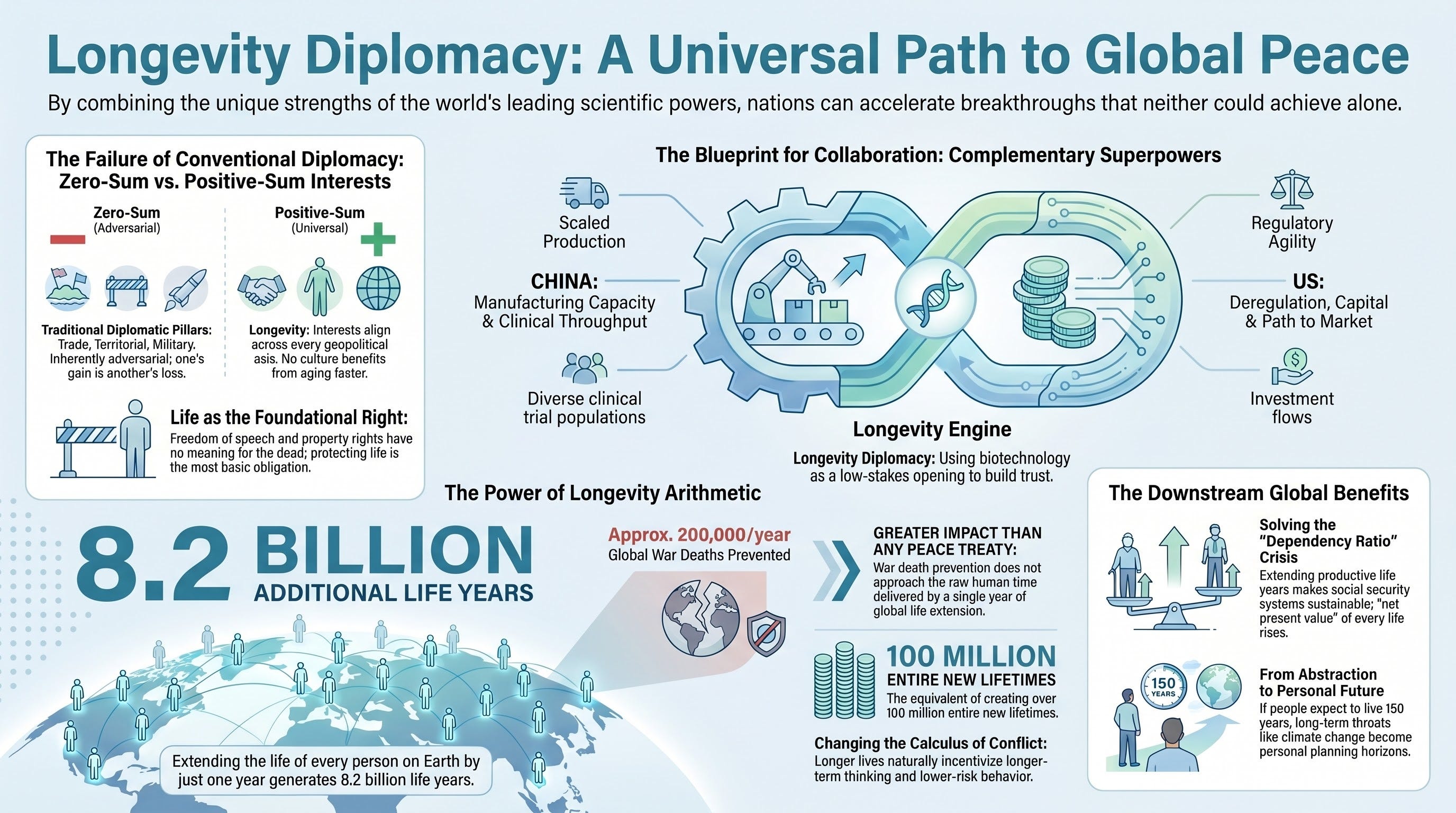
Because the obvious thing is this: the United States and China are not natural enemies in biotechnology. They are natural partners. China has built discovery infrastructure at a scale and speed no other nation can ever match: the manufacturing capacity, the clinical throughput, and, most importantly the depth of highly-qualified super-hardworking talent. It can make the discovery and development side of longevity dramatically cheaper and faster. The United States, in turn, can compete on what it does best when it chooses to: deregulation, capital formation, and the kind of bold approvals environment that lets breakthroughs reach patients. One side accelerates discovery, the other clears the path to market. Together they compress timelines that neither could compress alone.
A president willing to ignore the media circus could turn that complementarity into the defining collaboration of the century.
The one topic where everyone agrees - freedom to live is the most basic human right
Consider what divides the major powers. Trade policy: zero-sum by definition. Territorial claims: fundamentally adversarial. Military posture: inherently competitive. Even concepts that sound universal, like freedom of speech, fracture along cultural lines.
In some European nations, you can be arrested for posting something offensive online. In the United States, you can be fired and socially excluded for a joke involving race or gender. Some countries impose global taxation based on citizenship at birth, regardless of where you live or earn. No country offers absolute freedom. You choose which freedoms matter to you and accept the constraints that come with them and if you can move - you move.
But living longer, healthier, more capable lives? Every government on Earth wants that for its people. Every person on Earth wants it for themselves. There is no cultural, ideological, or political framework in which “I want my citizens to age faster and die sooner” makes sense as policy. Longevity is the rare domain where interests genuinely align across every axis of geopolitical competition.
The one constraint you cannot escape
You can avoid taxes. Surrender your citizenship, relocate to a jurisdiction that does not tax foreign income. People do this routinely. You can avoid conscription, censorship, or regulation by moving. If you don't like something - acquire a useful skill and move somewhere you like better. Every constraint that governments impose has an exit.
Aging has no exit.
You cannot choose a country where aging does not apply. You cannot buy your way out of cellular decline. You cannot negotiate with telomere attrition. I have written extensively about this reality: as I explored in How Much Can You Extend Your Life with Drugs?, no pharmaceutical intervention today meaningfully extends human lifespan. Not metformin, not rapamycin, not GLP-1 agonists (though they may be our closest candidates, as I discussed in GLP-1s: The world’s first longevity drug?). I examined the inconvenient truth about the Blue Zones and found that much of what we attribute to lifestyle is statistical artifact - you are better off living in Hong Kong, Singapore, Macau, Tokyo, Shanghai, or Monaco if you like high average life expectancies. I asked How Long Can Elon Live? and the answer, even for the world’s richest man with unlimited access to medical technology, is sobering.
The constraint is real. Aging is the deepest constraint on human freedom. Not political oppression, not economic inequality, not geographic accident. The fundamental limit on every human life is biological aging. Everything else is negotiable. This is not.
Life as the fundamental right
There is a hierarchy of human rights that most philosophical traditions, regardless of culture, acknowledge implicitly. Without life, no other right has meaning. Free speech is irrelevant to the dead. Property rights serve no one in a grave. Political participation requires a living participant. Life is not one right among many; it is the right that makes every other right possible.
If life is the foundational right (and I challenge anyone to argue otherwise), then extending healthy life in good function is not a luxury or a transhumanist fantasy. It is the most basic obligation of any society that claims to value human rights. And if no single nation can solve this problem alone (which it cannot: the biology is too complex, the clinical infrastructure too distributed, the talent too scattered), then collaboration is not idealism. It is necessity.
The science here serves the right, not the other way around. When we published Classifying aging as a disease in the context of ICD-11, the point was never merely taxonomic. If aging can be treated, then protecting and extending life moves from aspiration to action: resources should flow toward treatment, and because the problem is global, those resources must be global too. I return to what this means for human rights at the end of this piece, because it is the argument that matters most.
Dismissing the objections
The reflexive criticism falls into two categories, both shallow.
“Billionaires will live longer.” Perhaps, temporarily. But every medical advance in history has followed the same diffusion curve: expensive for early adopters, then universal within a generation. Antibiotics, vaccines, statins, MRI. The wealthy got them first. Then everyone did. Longevity therapeutics will follow the same trajectory, especially with AI compressing the development timeline. The question is not whether the rich benefit first; the question is how fast the technology reaches everyone. That timeline shortens with collaboration, lengthens with isolation.
“Bad leaders will live longer.” This objection assumes that aging is what removes leaders from power. It is not. Political succession across every system, democratic or otherwise, is governed by institutional structures, term limits, party rules, and constitutional mechanisms, not by biology. Leaders do not leave office because they got old; they leave because systems are built to replace them. Conflating aging with regime change is analytically lazy, and it has nothing to do with whether ordinary citizens deserve longer, healthier lives.
The unifying project
If you look past the woke longevity reflexes and consider the broader implications, longevity research may be the most naturally unifying project available to our species. Not because it sounds nice in a speech, but because the incentive structure genuinely aligns across competing powers.
China invests heavily in aging research and has built world-leading capacity to translate that research into therapies. Like every advanced economy, it faces a maturing population, and it is treating that challenge as a scientific and industrial priority. Europe’s dependency ratios are approaching unsustainable levels. The United States spends more on healthcare per capita than any nation and gets mediocre longevity outcomes. Every major power has the same problem, and no single power has the talent, infrastructure, data, and clinical capacity to solve it alone. China’s strength in discovery and development paired with American strength in deregulation and capital is the most powerful combination available.
This is where longevity differs from other grand projects. Space exploration is optional. We can survive perfectly well without Mars colonies (even though I hope we build them). Climate change requires sacrifice and redistribution, which makes agreement difficult. Nuclear disarmament requires trust that may never exist. But longevity research asks only that nations invest in their own citizens’ health while sharing what they learn. The Nash equilibrium favors cooperation because the returns from shared data and diversified clinical trials exceed what any isolated program can deliver.
The economics of longer life
There is a financial dimension that strengthens the argument further. When you extend healthy lifespan, you increase the net present value of every human life. A person who will live productively for 100 years generates more economic output, more innovation, more tax revenue than one who declines at 65 and dies at 78.
If you live long enough and work consistently, you accumulate wealth regardless of starting position. If you cannot work due to disability, the social systems required to support you become more sustainable as the productive population expands. With AI and humanoid robotics entering the labor market, the capacity of social security systems will increase dramatically over the next two decades. The “who pays for it” objection dissolves once you model the economics properly.
What remains is the most important asset allocation decision our species can make: investing in life itself.
Why I am a pacifist
I live with a conviction that may sound strange to some: our brains will eventually be transparent. In the future, there will be no secrets.There will be an “AI Judgement Day" if we live long enough. Knowing this, I do not spend time thinking about how to deceive, manipulate, or extract advantage from other and would never intentionally cause harm to another human being except in self-defence. I think instead about how to make maximum impact. And maximum impact, by the numbers, is longevity.
Consider the arithmetic. Approximately 68 million people die each year. The global population stands at roughly 8.2 billion. If you could extend every person’s life by just one year, you would generate 8.2 billion additional life-years. That is the equivalent of more than 100 million entire lifetimes. One year per person, universally applied, produces more life than the total population of most countries will ever experience across their entire histories.
No peace treaty, no humanitarian intervention, no disaster relief effort comes close to that scale of impact. Even preventing every war death on the planet (roughly 150,000-200,000 per year in the worst recent periods) does not approach what a single year of life extension, applied globally, would deliver in raw human time.
This is why I believe longevity is more important than peace itself. People will always fight. Conflict is embedded in human nature, in resource competition, in territorial instinct, in ideology. You cannot eliminate it. But you can make it less consequential relative to the total amount of life being lived. And here is the connection: the more life people have ahead of them, the less willing they are to waste it in conflict. A 25-year-old with 150 years ahead calculates risk very differently from one with 50. Longevity does not eliminate war, but it changes the calculus that leads to it.
A connected species
Once we collectively accept two premises (that extending healthy life is important and that it is possible) the geopolitical landscape shifts fundamentally. Longevity becomes a central organizing principle, not a fringe scientific interest.
The downstream effects are immediate. If you expect to be alive in 150 years, climate change is no longer an abstraction; it is your personal future. Global security is not your grandchildren’s problem; it is yours. Species survival over the long run becomes a practical planning horizon, not a philosophical exercise. Longer lives force longer thinking.
We can live without Mars. We cannot live without life. And the project of extending life is large enough, complex enough, and universal enough to function as the connective tissue between nations that otherwise struggle to find common ground.
The leaders who understand this will build the alliances that matter. The media that ridicules the conversation will, eventually, realize they were on the wrong side of it. And the research community, which has been working on this for decades (as we outlined in Artificial intelligence in longevity medicine for Nature Aging), will continue regardless of whether the press applauds or mocks.
The question is only whether we collaborate now, when it can accelerate progress, or later, when the cost of delay is measured in hundreds of millions of lives lost to a problem we knew how to approach but chose to ignore because the conversation made journalists uncomfortable. I have spent over two decades working on this. I know which side I am on, and I suspect most people, given the choice between collaboration and continued fragmentation, would choose the same.
Longevity is the most important human right
The right to live is the most important human right we have, because without it no other right carries any meaning. Freedom of speech, freedom of assembly, the right to property, the right to vote: all of them presuppose a living person to exercise them. A right that expires when you do is a right built on borrowed time. If we take human rights seriously, then we must take seriously the one right that underwrites all the others, and we must protect it with the same urgency we apply to liberty and dignity.
It is worth noticing that many of the countries scoring highest on conventional human rights indices do not have the highest life expectancy. The longest living cities in the world today are Hong Kong, Singapore, Tokyo, and Shanghai. There is a disconnect here that our scoring systems quietly ignore. If we genuinely believe that life is foundational, then longevity belongs inside the way we measure how well a society protects its people. A nation that keeps its citizens alive longer and healthier is doing something profound for human rights, and our metrics should say so.
Consider also the freedom of exit. Once you reach a certain level of wealth, or once you possess a rare and portable skill set, you can effectively choose your own set of freedoms by choosing which country or countries you live in. If you dislike the rights on offer in one place, you can leave for another. This is a real and growing form of agency. But no country, however free or however rich, can offer you the one thing you cannot opt out of: significantly longer life. You cannot emigrate your way out of aging. As populations grow wealthier and as this understanding spreads, people will begin to demand longevity from their leaders the way they now demand security and prosperity. Seen in this light, investing in longevity, deregulating biomedical research, permitting faster human experimentation, and building international collaborations are not the vanity projects of aging rulers clinging to power. They are a fight for the most basic human right, the right to live. Leaders across the political spectrum should be able to agree on this right and build their collaboration around it.
Longevity diplomacy
Longevity may be the single issue on which almost everyone on earth agrees. You can argue about nearly anything else. Even climate, which many treat as settled, divides leaders, and some of them genuinely do not perceive the urgency. But the desire to live longer and healthier, without the slow decline that robs us of our final decades, is close to universal. It crosses ideology, religion, and national interest.
Biotechnology is advancing very quickly. Countries like China are investing on two fronts at once: in the infrastructure that makes therapeutics faster and cheaper to develop, and in the deregulation and research aimed at genuinely new breakthrough treatments. When nations share the fruits of this research and collaborate on joint discoveries, they build something more durable than any single deal. They build cooperation, warmer relations, and trust. I call this longevity diplomacy: a low conflict on-ramp to cooperation between rivals who otherwise struggle to find common ground.
An opening for the next summit
I hope plainly that the September meeting between Trump and Xi includes a serious discussion of longevity biotechnology, and that it serves as the warm-up to the conversation. It is a friendly, low-stakes opening, and it can ease into the harder economic and political disputes that always follow. Climate can be contested; longevity cannot, because everyone agrees that it matters. Biotechnology is not yet so enormous an industry that the stakes poison the conversation, and although competition in the field is fierce, nations can still agree to collaborate for mutual benefit.
So here is my direct appeal. If you are reading this and you know either leader, plant this idea with them. Do it for your own benefit as much as anyone else’s, because we all want to live longer, better, and healthier.
The impending costs of treating long term debilitating illness will rise to unbearable heights if we fail to employ interventions that are already backed by compelling evidence.