

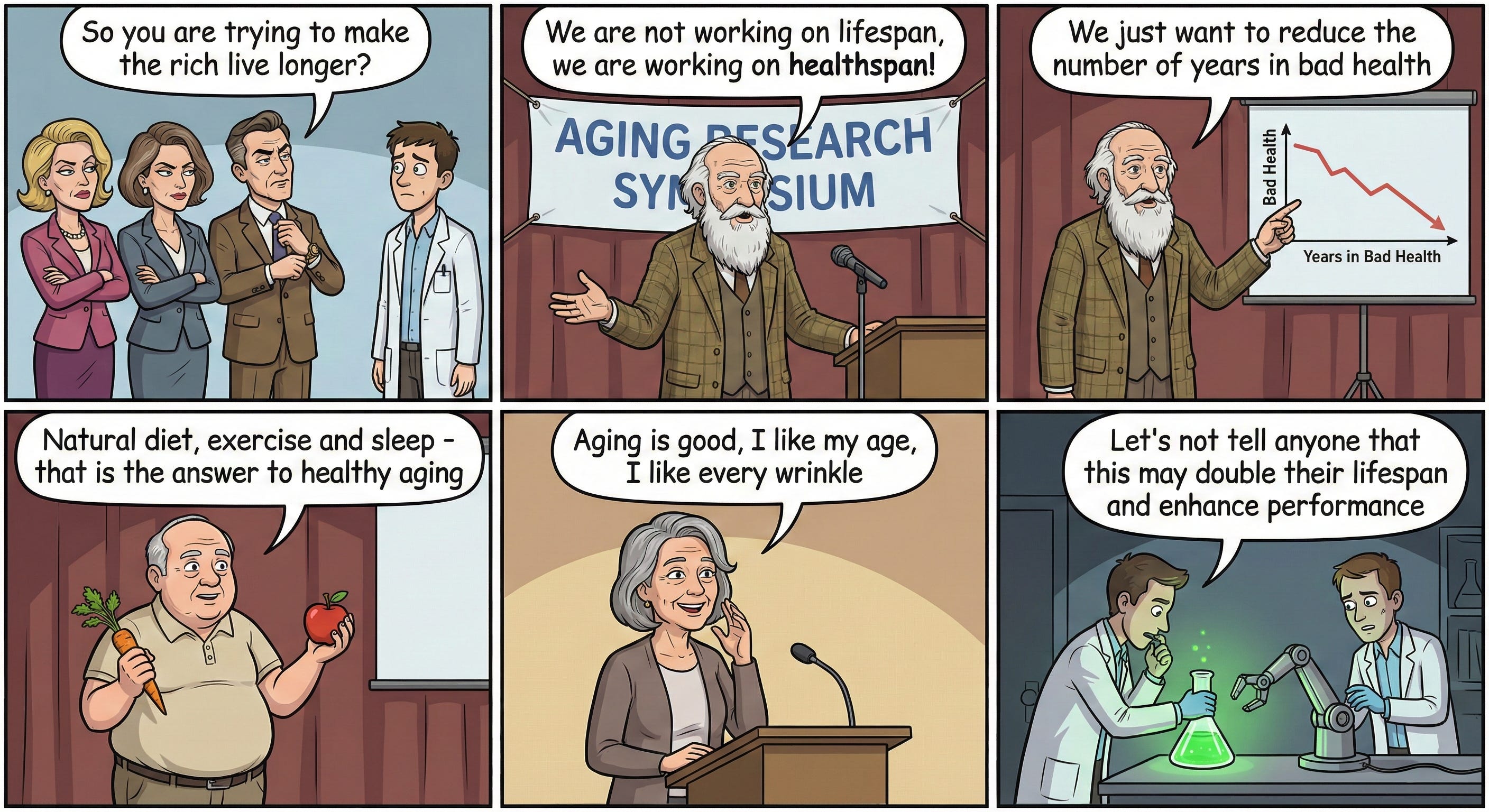
As world leaders gather in Davos and many of my friends in aging research organize side events on longevity, I want to share an observation that has bothered me for some time: the field of longevity has gone “woke.” This shift is inhibiting free thought and stifling new ideas that could significantly increase human lifespan. Every time I start talking about the therapeutic extension of human life, I hear the same refrain: “But you are extending healthspan, not lifespan, right?”
Well, ladies and gentlemen, let me be clear: to me, a Drug for Lifespan = a Drug for Healthspan. Unless you can show me a single drug or therapy that can give a person with an already optimized lifestyle just five extra years of life without extending their healthspan, I will not change my opinion.
Wokeness in Longevity
In 2024, I attended the World Economic Forum in Davos to give a talk on longevity. While standing in a hallway, I was approached by a group of young “Global Shapers” who asked what I was working on.
“I am in aging research to extend healthy, productive longevity,” I said.
“Oh, so you want the rich to live longer?” one asked immediately.
I was surprised but answered calmly, “I want everyone to live longer. But right now, nobody lives longer. We don’t live to 90 on average, and the maximum is still 122.5. We need to change that.”
“But it will only be available to the rich,” she pressed on.
“It will be like a personal computer or cell phone—originally available to the rich, but with scale, available to everyone. That is how technology works. Let’s get there first,” I replied.
“But what about poor nations? We need to have parity,” she continued.
I admit, I felt a bit irritated but did not show it.
“Imagine that we are in the year 1900,” I said. “I am working on the airplane, and you are asking me if it will only be available to the rich. Does it really matter yet? We do not have the plane. Should we argue about who flies in business class if we don’t have a plane? What kind of innovators are we if we start thinking about who gets to use the technology when there is no technology?”
That argument resonated, and we switched to questions on overpopulation, which I answered in much the same way. When I mentioned that I am also working on carbon capture and sustainability technologies, they warmed up a bit.
But then, the debate returned. “But you are working on healthspan and not lifespan, right? It is very important to extend the healthy portion of life,” another Global Shaper asked. She seemed familiar with the standard lifespan vs. healthspan debate.
“Can you give me one example of any drug that can significantly increase lifespan and not healthspan? Even by five years?” I asked.
I thought she would be stuck there—because there is no answer.
“That is why I am asking if the drugs you are working on are focused on healthspan or lifespan,” she continued.
I pivoted the conversation there and asked: “What made you ask this question? If I were to encounter someone in this field, I would first ask about biological mechanisms, discovery methods, current results, or challenges. Instead, we are talking about the potential negatives of a technology that does not yet exist. There is nothing that can give you an extra 10 years of life if you are already fit and doing regular diagnostics.”
My View on Healthspan vs. Lifespan
Until you show me a pill or any other intervention that can give me—someone who is already optimized and goes for regular diagnostics—5 years of extra “poor quality life,” Lifespan and Healthspan are the same thing.
By the way, even if I could get 30 years of extra “bad life” with pain and diseases, I would still take it. So would most other people—they don’t want to die and want to see a bit more life. Anyone who argues otherwise should logically be arguing for euthanasia or mandatory termination after reaching the end of their healthspan.
We must stop arguing about whether aging is a disease or if we are extending healthspan. We need to relentlessly focus on identifying new interventions to push human lifespan and performance beyond currently acceptable limits. Endless debates on lifespan vs. healthspan just give people without new ideas a platform to speak.
Aging is our common and most important enemy. It drives the decline of all biological functions, leading inevitably to disease and death. It is 100% guaranteed to take everything from us, yet we fixate on lesser issues—regional conflicts, partisan politics, income inequality, gender debates, bathrooms, and pronouns. Simultaneously, we strategically deceive ourselves to avoid fighting, or even acknowledging, the reality of aging while 160 thousand people die every day.
I committed my life to aging research over 20 years ago. I have watched the field transform from snake oil and small-scale experiments into an industry defined by massive initiatives like Calico and Altos. Today, we are seeing the first sustainable business models and the arrival of the first wave of longevity therapeutics, such as GLP-1s and other incretins. Now is the time to push full steam ahead on interventions targeting muscle wasting, neurodegeneration, ocular disease, hair loss, and performance augmentation.
However, the emergence of “wokeness” in longevity is a new and concerning obstacle. this trend even affected the ARDD conference. Many talks, especially those polished by consultants make extra cautious remarks about healthspan vs lifespan and focus on disease avoidance rather than significant increases in lifespan. In my opinion, before we obsess over the potential downsides or unequal distribution of life-extension technologies, we must actually invent them. Nothing is more urgent—we are all on the clock.
What do you think about this trend? Feel free to share your opinions in comments.
Interesting to get your perspective on this and I couldn’t agree that the pushback is unnecessary.
However one paragraph really stuck with me: „By the way, even if I could get 30 years of extra “bad life” with pain and diseases, I would still take it. So would most other people—they don’t want to die and want to see a bit more life. Anyone who argues otherwise should logically be arguing for euthanasia or mandatory termination after reaching the end of their healthspan.”
When working on geriatrics on oncology wards you are seeing so much pain and suffering. I’ve meant numerous patients who didn’t want to go on like that, they said „they’d had enough” and were „ready”. Perhaps our fear of death changes as years go on.
Maybe you are not talking here about living with pain and disease to such extent but my life lessons from geriatrics medicine came to mind immediately.
Quality of life is absolutely critical to me, thus "healthspan" has been my focus (even though I'm personally aiming to make it to 120). This article was a bit of a wake up though, in that the two can't really be separated.
The "woke" logic seems idiotic. Of course new technologies will be expensive and only available to the wealthy. You covered that wonderfully.