

I want to start with a number, because the number is the only thing that has ever made this worth doing.
One extra year of life for every person alive today is roughly 8.3 billion life years. Divide that by a human lifespan and you get about 110 million lifetimes. One hundred and ten million complete human lives, conjured out of a single year added to each of us. Specific diseases affect a fraction of the population for a limited stretch of years. Aging reaches 100 percent of us, over an entire lifetime. There is no other intervention I can think of, no policy, no technology, no act of generosity, that produces a return on that scale. A single drug that reliably added one year of healthy life to everyone would be the largest humanitarian act in the history of our species.
Now here is the problem that has kept me up at night for most of my adult life. After more than 150 years of modern pharmacology, there is no drug that can give a year of life extra to a healthy optimized individual with a deep diagnostic screening routine. Not one drug with conclusive clinical evidence. If you are already healthy, exercising, sleeping well, avoiding obvious risks, and doing serious diagnostics to catch problems early, there is no pill on earth that has been proven in a controlled human trial to give you even one additional year. It does not matter how rich you are. You cannot buy that year. The geroprotectors that longevity enthusiasts talk about most, metformin, rapamycin, the SGLT2 inhibitors, are interesting molecules with real biology behind them, but none of them has been shown in humans to add a single year of life to an already optimized person. I have written before about how little we actually know about drugs and lifespan, and the honest answer, stripped of hype, is that the shelf is empty.
So imagine deciding, with full knowledge of that emptiness, that you are going to be the one to fill it. Any single new drug, for any disease, costs somewhere in the billions of dollars to develop and carries a probability of success below one percent. You are volunteering for a task that the entire pharmaceutical industry, across a century and a half, with all its money and all its brilliance, has failed to accomplish. By any reasonable measure, it is an impossible task.
And yet the math at the top of this page justifies attempting the impossible. If there is even a small chance of giving humanity a real geroprotector, the expected value of trying, measured in lifetimes, dwarfs almost anything else a person could do with their time. That is the calculation I made in 2014. I have never regretted it, though I have questioned it more than once along the way.
2014: The Launch of Insilico and Nvidia GTC
In The Lord of the Rings, Frodo does not volunteer because he is strong or qualified. He volunteers because the thing has to be carried to Mordor and no one else will step forward to do it. That is roughly how I felt when I founded Insilico Medicine in 2014. Aging is the world’s greatest evil, the thing that will, with total certainty, take everyone you love and eventually you. And the ring that had to be carried into the mountain was a drug that could actually slow it.
I set off with a conviction that the tools of artificial intelligence, then only beginning to work in narrow domains, could be turned on the two hardest problems in drug discovery: finding the right target, and designing the right molecule to hit it. Everything else was going to have to be assembled along the way.
The first years were side quests, in the truest sense of the phrase. Before you can march on Mordor you have to survive, and a biotech company that runs out of money is a fellowship that dissolves in the first town. We spent those years building Pharma AI, the platform that would eventually let us generate hypotheses about aging and test them at a speed no academic lab could match. We also built a business that could pay for the journey. This is the least romantic part of the story, and also the most decisive. Until 2019 we lived quarter to quarter, iterating algorithms faster than the field could publish them, keeping the lights on with collaborations while pouring effort into aging research, biomarkers, and deep aging clocks in parallel. That early commitment to longevity was the reason the company existed.
There are, broadly, three ways to fund a serious assault on aging. The first is a massive government program, something on the scale of the National Institute on Aging, patient and well-funded but slow, diffuse, and rarely aimed at a single deliverable drug. The second is a massive infusion of private capital up front, the Calico and Altos Labs model, where you raise billions and hire the best minds and hope the runway lasts long enough. The third is what we chose: an organic, sustainable business, one that earns its own way by licensing its AI and its molecules to the industry while quietly pursuing its own long-term mission with the proceeds.
I chose the third path deliberately. A ship that earns its own keep is hard to sink. When the market turns, when a trial disappoints, when capital gets expensive, a company that depends entirely on the next fundraise can vanish overnight. We built Insilico to survive the long journey, because I always assumed the journey would be long. A concrete turning point arrived in September 2019, when we published GENTRL in Nature Biotechnology, showing generative AI that could move from design to a validated hit in weeks, a stretch that used to take years. That paper changed the conversation around the company and our capital position. Thirteen of the top twenty pharmaceutical companies now use our platform. That revenue pays for the provisions. The mission remains aging.
2019: The Main Quest Begins
By 2019 the fellowship was assembled and provisioned, and it was time to actually walk toward the mountain. We still had to deviate into side quests for resources, but the main quest finally had a name and a direction.
The central strategic problem in longevity is that “aging” is not a disease any regulator will approve a drug for. You cannot run a trial with the endpoint “lives longer” in any timeframe that a company or a patient can tolerate. So the field has mostly been stuck between two bad options: repurpose old, off-patent generics like metformin and rapamycin, which cannot support a viable business or generate the clean data a real approval needs; or chase aging in the abstract and run into a regulatory wall.
Our answer was a different framing entirely. Start with aging biology. Find a target that sits at the intersection of the fundamental hallmarks of aging and a specific, approvable disease. Design a drug against that target. Win approval in the disease first, because that is the only route that has funding and a regulatory pathway. Then let the aging signal reveal itself in the biomarkers along the way. The loop is simple to state and hard to execute: aging leads to disease, disease justifies a drug, one drug can serve multiple indications, and all of it feeds back into our understanding of aging. A dual-purpose target. Aging biology was baked into target discovery from day one. We did not wait around hoping a lucky aging signal would appear after a disease drug already existed.
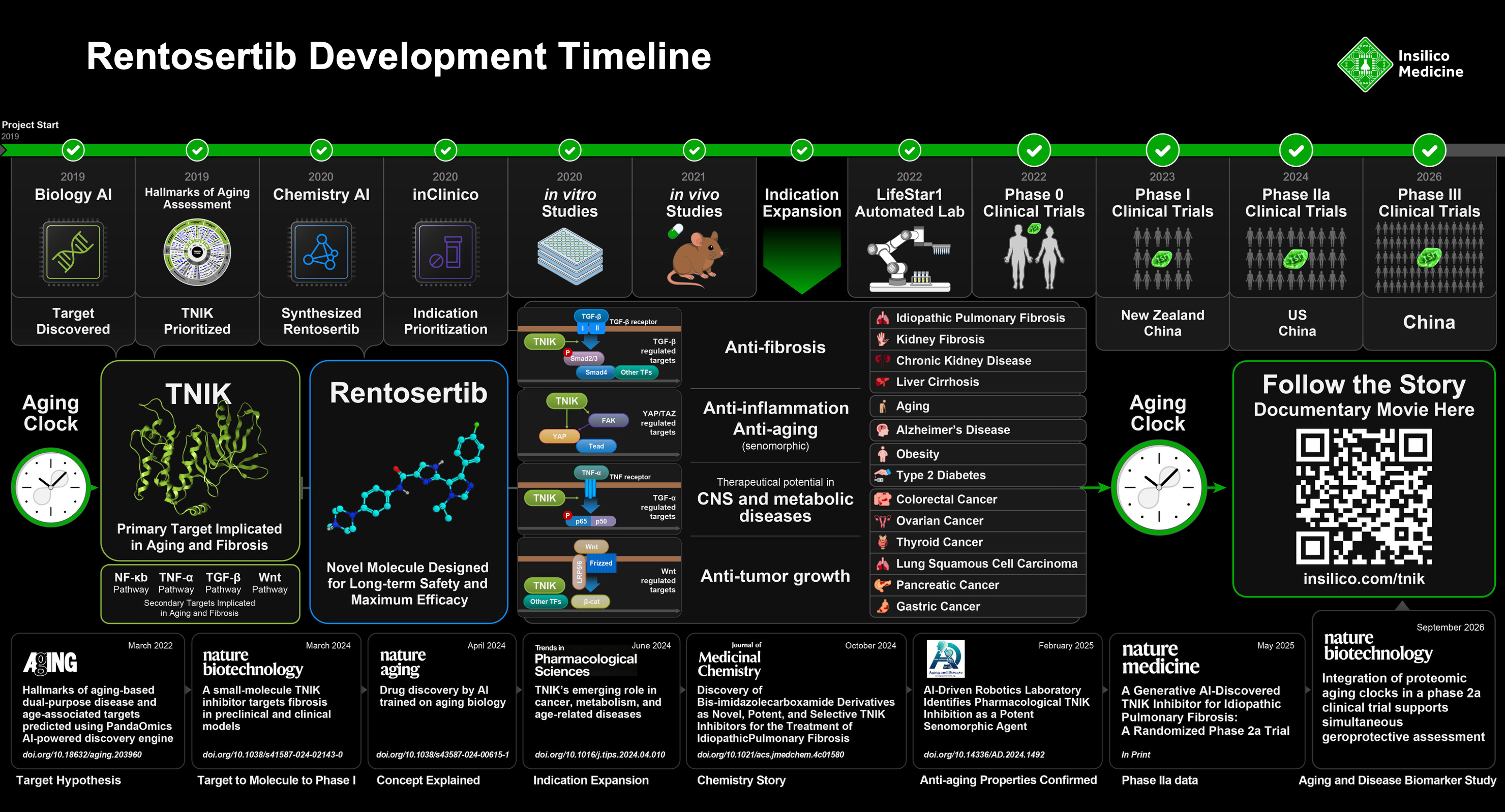
Our AI, sifting through enormous datasets of tissue, disease, and aging biology, kept surfacing the same protein: TNIK. When we mapped it, TNIK connected to six of the recognized hallmarks of aging, a master regulator sitting near the center of the web. The question then became which disease was the right gateway: which condition is, in effect, aging in fast-forward, so that a drug slowing it might also be slowing the underlying process.
We chose idiopathic pulmonary fibrosis. IPF is sometimes called the Alzheimer’s of the lungs, a relentless scarring of lung tissue that steadily strangles a person’s ability to breathe. Median survival after diagnosis is around four years. Patients are often diagnosed only after they have already lost roughly 20 percent of lung capacity. It is a disease in which fibrosis, chronic inflammation, extracellular matrix remodeling, and cellular senescence all intersect, which is to say it is one of the clearest clinical windows we have onto accelerated aging. My co-CEO and chief scientific officer, Dr. Feng Ren, has put it cleanly: “IPF is one of the clearest clinical examples of an age-related disease in which fibrosis, chronic inflammation, extracellular matrix remodeling and cellular senescence intersect.” If TNIK inhibition could bend the curve of IPF, that would be both a medicine for a lethal disease and the first real test of the aging hypothesis in humans.
Then our generative chemistry system, Chemistry42, went to work designing the molecule. This is the part where AI changes the physics of the problem. As I told the New York Times, the process is like scanning a lock and generating a key that fits it. The system architects candidate molecules atom by atom to bind a specific target with maximum efficacy and long-term safety, exploring chemical space no human medicinal chemist would have time to traverse. Out of that process came rentosertib, then called ISM001-055, a first-in-class small molecule inhibitor of TNIK. For that program we synthesized 79 molecules on the way to a preclinical candidate. That is still a small number next to traditional campaigns, and it is large enough to remind you that “AI designed the drug” still means chemists, biologists, and toxicologists spent years turning a generated structure into something you can put into a human being.
The speed still surprises people. From selecting the target to nominating a preclinical candidate took about 18 months. The industry average for that same stretch is closer to four and a half years. We published the preclinical foundation in Nature Biotechnology in 2024. That acceleration comes from a specific place, and it matters for the rest of this story. Where AI actually helps most is in the early territory, between target discovery and the preclinical candidate. Once you cross into human trials, you enter super-regulated ground where physical time constraints and safety requirements govern the pace, and no algorithm moves a Phase III trial faster than biology and regulators allow. The mountain itself stays put. AI gets you to the foot of it years ahead of schedule.
The Drug Takes Shape
A designed molecule is a hypothesis, nothing more. It has to survive contact with living systems. A preclinical candidate is still far from a drug. The distinction matters, especially when people compress an entire decade of work into the phrase “AI discovered a drug.”
In preclinical work, TNIK inhibition did what the aging biology predicted it should: it suppressed the formation of senescent cells and corrected aspects of metabolic dysfunction. Then came the human phases. Phase 0 and Phase I, running from 2020 through 2022, established that the molecule was safe in people and behaved predictably in the body, giving us the pharmacokinetic profile we needed. These are the unglamorous stretches of the journey, the long marches where nothing dramatic happens and everything depends on nothing going wrong.
The real test was the Phase IIa trial, run across 21 sites in China (NCT05938920), and its results were published in Nature Medicine in June 2025. The headline measure in IPF is forced vital capacity, or FVC, the total volume of air a person can exhale. It turns out to be a remarkably clean biomarker of aging as well as of lung disease.
Here is the translation into the language of aging that I wish more people would sit with. A healthy adult loses somewhere between 20 and 50 milliliters of FVC per year to normal aging. Untreated IPF accelerates that loss to 150 to 200 milliliters a year. Even with existing standard-of-care drugs, treated IPF patients can still lose on the order of 70 to 210 milliliters a year. Those drugs are considered successful when they slow the decline. They stall the disease. Lung volume does not return.
In the trial, patients on the 60 mg once-daily dose of rentosertib showed a mean FVC improvement of about 98.4 milliliters over 12 weeks, against a mean decline of about 20.3 milliliters in the placebo group. Read that again in the language of aging: a gain of roughly 98 milliliters is on the order of a full year of normal age-related lung decline given back, in three months, in a disease that usually only takes. To my knowledge this is the first time a drug in this setting has pointed toward reversing lung damage, beyond the usual goal of holding the line against further loss. It was the first real evidence that we were treating a disease and touching the process underneath it at the same time.
Reaching Mordor (Almost)

On September 7, 2026, we published the paper I had been walking toward for seven years, in Nature Biotechnology. It is the reason I am writing this piece, and it is freely available to read.
Using the longitudinal blood samples collected during that same Phase IIa trial, we measured thousands of proteins in each patient before and after treatment (2,841 proteins in the reported analyses), and we ran those measurements through six independently developed proteomic aging clocks. These clocks, built by teams at Harvard, Oxford, Peking University, and Insilico, are AI models that predict a person’s biological age from the pattern of proteins in their blood. Some predict chronological age; others predict mortality risk. The set included ProtAge, OrganAge (chronological and mortality variants), PAC, ipfP3GPT, and PAOPAC. Crucially, they do not share their underlying features or their training data. They are six different instruments, built by different people, looking at the same patients.
We chose proteomics deliberately. Each protein is a gene product on a pathway, often a drug target itself. Serum aggregates signal from tissues across the body. Proteins are clinic-ready biomarkers that regulators and physicians already know how to argue about. For an anti-aging read embedded inside a disease trial, that modality was the right instrument.
All six agreed. Every clock showed a reduction in predicted biological age after 12 weeks of treatment, while the placebo group barely moved. The peak effect landed at week 4 on the 30 mg twice-daily regimen, with a consensus reduction of roughly three to four years of biological age, and as much as six years on one clock. Twenty-one of the fifty-four cross-clock comparisons reached statistical significance.
Unanimous agreement is rare in science, and it is the part that the outside experts found most persuasive. As the Nobel laureate Michael Levitt put it, what convinces him is the agreement across models that share neither their features nor their training data, more than the size of any single effect. Vadim Gladyshev of Harvard Medical School, who helped build one of the clocks, described it to the New York Times as the first study that shows, very clearly, that predicted biological age can be reduced. Evelyne Bischof, a longevity medicine specialist and professor of medicine at Tel Aviv University, told the same paper that these are methods researchers will use in future trials. Eric Topol, the author of Super Agers, told the New York Times: “This drug looks encouraging. But we do not yet have a definitive trial to make the final judgment.” That is perhaps the outcome I care about most: a map other researchers can now follow, with the honest caveats still attached.
The effect was not confined to the lungs. Organ-specific clocks revealed a systemic shift. The arterial clock showed the strongest reduction, up to 16.57 years on the 60 mg once-daily arm at week 12. The brain clock showed up to 8.5 years, the pancreas up to 6.6 years, the immune system up to 5.56 years, the stomach up to 1.73 years. The rejuvenation signal, whatever it represents, radiated outward from the target organ into the rest of the body.
Two mechanisms appear to be doing the work, and both are consistent with what we already know about aging biology. The first is a senomorphic effect: rentosertib suppressed the senescence-associated secretory signature captured by the SenMayo gene set and shifted senescence-repressing genes captured by CellAge. In plain terms, it quieted the inflammatory output of aging, senescent cells. The second is that it coordinately suppressed nutrient-sensing and growth-factor signaling pathways, the very same fundamental aging drivers targeted by caloric restriction and by rapamycin. A molecule we designed to treat a lung disease was, independently, pulling on the two oldest and best-validated levers in the entire field of geroscience.
We then compared the pattern of change against the UK Biobank, 55,319 older adults, and asked whether rentosertib reverses the protein trajectories that normally worsen with age across the general population. Across hundreds of age-associated proteins, the answer was a significant negative correlation (Spearman’s r = -0.30, P < 0.01). The drug preferentially reversed the age-associated proteomic changes seen as people grow older. And the pharmacodynamics told their own story: the dose that helped the lungs most (60 mg once daily, a high-dose surge) was different from the dose that most reduced biological age (30 mg twice daily, a continuous steady state). That dissociation matters. It suggests the aging effect may run partly independently of the lung improvement. The two respond to different dosing, which means they may be, at least partly, different phenomena. If that holds, it will shape how every future dual-purpose longevity trial is dosed.
The Final Battle
Phase III is now underway. This is the final battle, the one that determines whether the whole journey mattered for patients who are running out of breath. By the time it completes, the total arc, from setting out in 2014 to a definitive readout, will run to roughly ten years. From AI discovery to Phase III in less than a decade is fast by industry standards. It is still a decade of life. And it is important to recognize the efforts of my quest fellows and the vision of the investors that gave us the ability to continue this quest.
I have thought a great deal about whether it was worth it. I am not going to pretend the alternative did not exist. The same seven, soon to be ten, years could have been spent accumulating wealth, traveling, resting, living an easier life. There were stretches of this journey when that alternative looked very reasonable.
But I keep coming back to the number I opened with. If there is even a modest probability that this work, or the strategy behind it, contributes to a drug that gives people more healthy years, then set that small probability against 110 million lifetimes and the expected value is not close. No amount of personal comfort weighs against even a fractional chance at that. I did not spend a decade because I was certain it would work. Almost nothing in drug discovery works. I spent it because the size of the prize made the long odds worth accepting, and because someone had to carry the thing toward the mountain.
That is also, I think, the honest answer to the question I get asked most: why aging, why not something easier. Because aging is the one problem where the arithmetic of trying is unlike any other in medicine. I have written elsewhere about what the real destination beyond healthspan even looks like, the idea of peakspan: keeping people alive, healthy, and at the peak of their capacity for as long as possible. That is the mountain. We have not reached the summit. For the first time, though, I can see it, and I can point to it with data as well as conviction.
An Army of Programs

If this were only about a single molecule, it would be a fragile kind of hope. One candidate, one trial, one target, is easy to lose in a mountain.
Rentosertib is the program that reached the mountain first, but it is one fellowship among many. Across our pipeline we are pursuing dozens of other programs, more than forty in total when you count the full portfolio, each one purposed to a specific disease under the same dual-purpose logic that produced rentosertib. TNIK for fibrosis sits alongside programs spanning oncology, immunology, metabolic disease, neurological conditions, and cardiovascular and kidney disease, with related dual-purpose work on targets such as PHD1/2, QPCTL, NLRP3, and TEAD. Each is its own fellowship, provisioned and marching, and the strategy is deliberately built so that no single failure sinks the mission. Sending an entire army is how you give a hard problem more than one chance. (None of this is investment advice; pipeline counts move, and clinical success is decided by trial data.)
There is one more thing worth recording here, without treating it as a triumphant coda. On September 17, 2026, we published a paper in Cell, in collaboration with Liquid AI, the Buck Institute, Harvard Medical School, and Brigham and Women’s Hospital, releasing three tools to the wider field: LongevityBench, an open benchmark for testing whether AI systems can actually reason about aging biology; a family of open-source Longevity-LLMs; and LongevityClaw, an agentic research platform for aging target discovery. All of it is open. We put it out because no single company, ours included, is going to solve aging alone, and the more travelers who are properly armed for their own quests, the better the odds that at least one of us reaches the mountain and comes back.
Frodo did not carry the ring alone, and he did not carry it because he expected to survive the journey. He carried it because the alternative was to let the evil stand unopposed. That is the closest I can come to explaining why I have spent the best years of my working life on a drug against aging, and why I would make the same choice again tomorrow.
The final battle is being fought now. I do not know yet whether we will win it. I know the number that sent us out, and I know it was worth the walk.
Inspiring i have a few ideas myself that i might persue
Thank you, Alex !