

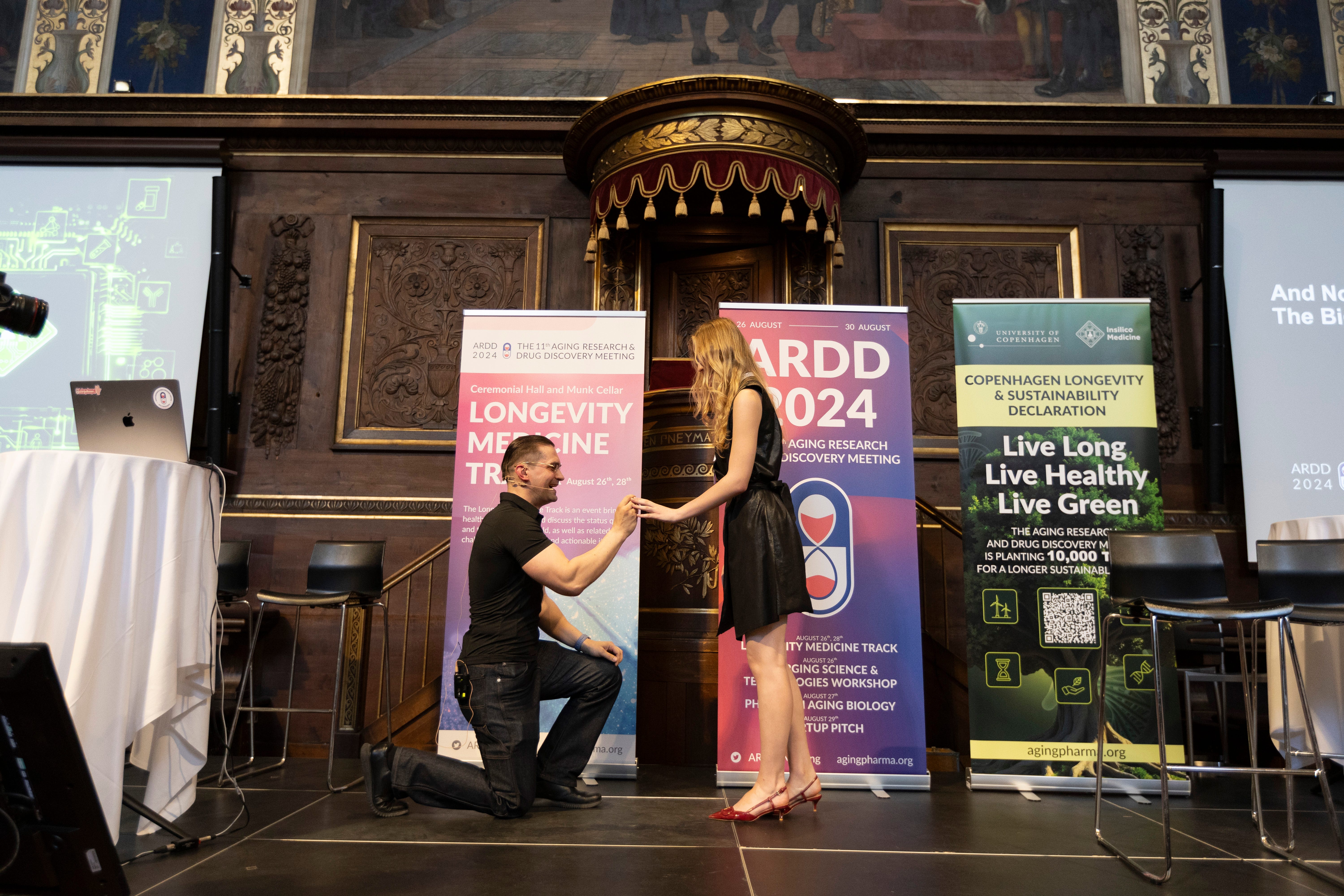
Many of my friends and colleagues will remember my Longevity Pledge. I wrote it after more than two decades in this field, when I decided to formalize my commitment to one cause, and it contained a promise about my personal life. I wrote: “I pledge to spend 100% of my time and personal resources to accelerate research and clinical deployment of longevity technologies.” And then, a few lines later: “At present, I am not married and do not have kids. I calculated that I could probably spend 6-7 hours a week on my personal life, and I didn’t want to disappoint anyone by being a bad husband or a bad father. I will not marry until I meet someone as dedicated to the cause as I am.”
I meant it. Then in July 2026 I published a post on LinkedIn: “My fiancé shares the same passion and mission as me - we work to extend healthy productive longevity for everyone on the planet.” I added: “This means that we will not see each other as often as we should (this is really hard work) but we will be doing our best to advance the mission.” I signed it “#LongevityCouple”.
So this post is a little different from my usual pieces on AI drug discovery, aging clocks and clinical data. It is about love, purpose and the will to live, and about a problem I believe our field should name out loud: longevity inequality. My thesis is simple. The data strongly suggest that close relationships and a sense of purpose are associated with longer and healthier lives. Yet the biology of aging is unfair to couples, and especially to women, who on average outlive their male partners and spend many of their final years without them. Lifestyle and social policy can soften this, and in my view longevity biotechnology is the only durable fix.
Let me start with the data.
What the data say about connection and survival
The most cited number in this area comes from a 2010 meta-analysis in PLoS Medicine by Julianne Holt-Lunstad, Timothy Smith and Bradley Layton. Across 148 studies with 308,849 participants, people with stronger social relationships had a 50% increased likelihood of survival (OR 1.50, 95% CI 1.42 to 1.59) over an average follow-up of about 7.5 years. The association held across age, sex, initial health status and cause of death, and it was strongest for complex measures of social integration (OR 1.91). The authors concluded that the influence of social relationships on mortality risk is comparable with well-established risk factors.
Five years later, the same group separated the objective and subjective sides of being alone. In a 2015 meta-analysis in Perspectives on Psychological Science, social isolation, loneliness and living alone were associated with 29%, 26% and 32% increased likelihood of mortality, respectively, after adjusting for confounders. Interestingly, objective isolation and the feeling of loneliness carried similar risk, and social deficits were more predictive of death in samples with an average age younger than 65.
The longest-running window into this question is the Harvard Study of Adult Development, which began tracking 268 Harvard sophomores in 1938 and later added 456 Boston inner-city residents from the Glueck Study. In the peer-reviewed analysis by George Vaillant and Kenneth Mukamal that followed 237 college men and 332 core-city men for 60 years, healthy aging at 70 to 80 could be predicted by variables measured before age 50, and marital stability was one of the seven factors under at least some personal control. The current director, Robert Waldinger, summarized decades of follow-up this way in the Harvard Gazette: “The people who were the most satisfied in their relationships at age 50 were the healthiest at age 80.” In a daily-diary study of 47 couples in their 80s, Waldinger and Marc Schulz found that marital satisfaction buffered the link between days of poorer perceived health and lower happiness.
Marriage itself has been studied in very large samples. A 2007 meta-analysis of 53 comparisons covering more than 250,000 older adults found a relative risk of death of 0.88 for married versus non-married individuals, with widowed (RR 1.11), divorced or separated (RR 1.16) and never-married (RR 1.11) people all at higher risk. Quality matters as well as status. A 2014 meta-analysis in Psychological Bulletin covering 126 studies and more than 72,000 people found that greater marital quality was associated with better health, including lower mortality risk, with effect sizes similar in magnitude to those of health behaviors such as diet.
The flip side is the widowhood effect. In a nationally representative cohort of 373,189 elderly married couples in the United States followed from 1993 to 2002, Felix Elwert and Nicholas Christakis found that the death of a wife was associated with an 18% increase in all-cause mortality for men (HR 1.18) and the death of a husband with a 16% increase for women (HR 1.16). The effect appeared across almost every cause of death of both spouses, which suggests it touches many systems of human biology at once. Even the illness of a spouse leaves a mark: in a study of 518,240 Medicare couples, Christakis and Paul Allison showed that hospitalization of a spouse for conditions such as dementia, stroke or heart failure was associated with a higher risk of death for the partner. A meta-analysis of 15 cohorts with 2,263,888 people put the overall risk at 1.41 in the first six months after bereavement and 1.14 afterwards.
The heart is where grief becomes visible to cardiologists. The neurohumoral features of takotsubo cardiomyopathy, widely called broken-heart syndrome, were described in a landmark NEJM paper by Ilan Wittstein and colleagues at Johns Hopkins, who studied 19 patients with severe, reversible left ventricular dysfunction after sudden emotional stress, 95% of them women, with catecholamine levels far above those seen in myocardial infarction. The International Takotsubo Registry later reported that 89.8% of 1,750 patients were women, with a mean age of 66.8 years. Beyond takotsubo, the incidence of acute myocardial infarction was elevated 21.1-fold within 24 hours of the death of a significant person, and a UK primary-care study of more than 30,000 bereaved older adults found that the rate of myocardial infarction or stroke roughly doubled within 30 days of a partner’s death (IRR 2.20).
Loneliness leaves a molecular signature
For someone whose group has been publishing deep learning aging clocks since 2015, the most interesting question is whether social connection shows up in biological age. The evidence is accumulating, and it points in a consistent direction.
In a 2016 PNAS paper using four nationally representative US samples, Yang Claire Yang and colleagues found that social integration was associated with lower risk of physiological dysregulation in a dose-response manner, and that the effect of social isolation on hypertension in old age exceeded that of clinical risk factors such as diabetes. In 4,018 participants of the Health and Retirement Study, baseline loneliness was associated with faster GrimAge epigenetic aging, and GrimAge partly mediated the link between loneliness and the accumulation of chronic disease. A 2026 HRS analysis by Feifei Bu and Daisy Fancourt found that social isolation was associated with accelerated second- and third-generation epigenetic clocks at 10-year follow-up, with the fastest epigenetic aging among people who were isolated, lonely and in poor-quality relationships. A 2026 meta-analysis of 22 studies concluded that loneliness, depression and stress were each associated with higher epigenetic age acceleration from midlife onward.
Proteomics tells a similar story. Across 42,062 UK Biobank participants and 2,920 plasma proteins, Chun Shen and colleagues identified proteomic signatures of social isolation and loneliness involved in inflammation, antiviral responses and complement, and more than half of these proteins were prospectively linked to cardiovascular disease, type 2 diabetes, stroke and mortality over 14 years. My colleagues and I have looked at this from the aging clock side. In a 2022 study led by Fedor Galkin, we built a deep learning aging clock on blood test data from the China Health and Retirement Longitudinal Study and found that psychological factors such as feeling unhappy or being lonely added up to 1.65 years to biological age, an aggregate effect larger than that of biological sex, living area, marital status or smoking status in that cohort.
The honest part: almost all of these studies are observational. They show associations, and the authors are careful to say that causality is difficult to establish. People who are healthier may find it easier to build and keep relationships, and shared lifestyle, income and education confound much of the data. None of these results conclusively proves that love extends lifespan. Still, the association is large, consistent across cohorts and methods, and visible in the biomarkers we use to measure aging.
Purpose and the will to live
If relationships are one pillar of the will to live, purpose is the other. I described my own motivation in a 2022 interview with Lindus Health this way: “I’m actually fine with dying; I’m just not fine with declining!” For me, purpose is what makes decline unacceptable and progress worth the effort.
The data on purpose are striking. Patrick Hill and Nicholas Turiano analyzed 6,163 adults in the Midlife in the United States (MIDUS) study and found that purposeful individuals lived longer over 14 years of follow-up: for each standard deviation increase in purpose, the risk of dying over the next 14 years fell by 15% (HR 0.85), and the benefit did not depend on age or retirement status. In 6,985 adults older than 50 in the Health and Retirement Study, Aliya Alimujiang and colleagues reported that people in the lowest life-purpose category had a hazard ratio of 2.43 for all-cause mortality compared with those in the highest category, and 2.66 for heart, circulatory and blood conditions. A meta-analysis of 10 prospective studies with 136,265 participants estimated a pooled relative risk of 0.83 for both all-cause mortality and cardiovascular events among people with higher purpose in life.
Some of the most careful work comes from Patricia Boyle and the Rush Memory and Aging Project in Chicago, which follows older adults with annual clinical evaluations and brain autopsy at death. In 1,238 older persons from this project and the Minority Aging Research Study, a higher purpose-in-life score was associated with a substantially reduced risk of mortality (HR 0.60); a person at the 90th percentile of purpose had about 57% of the hazard of a person at the 10th percentile. In 951 participants followed for up to seven years, people with high purpose were approximately 2.4 times more likely to remain free of Alzheimer’s disease (HR 0.48) and also had lower risk of mild cognitive impairment and slower cognitive decline. In the same Chicago cohort, Robert Wilson and colleagues found that the risk of Alzheimer’s disease was more than doubled in lonely persons compared with people who were not lonely.
Put these two literatures together and a pattern emerges. People who have someone to live with and something to live for tend to live longer, decline more slowly and keep their cognitive function longer. In my own life, love and purpose have become closely intertwined.
Longevity inequality: the years women spend alone
Now to the new idea. Most people know that women live longer than men. Fewer think through what this means for couples.
The gap is global. According to the WHO Global Health Observatory, global life expectancy at birth in 2023 was 76.1 years for women and 70.6 years for men, a gap of 5.5 years. In the same WHO data the gap was 12.4 years in Russia (78.7 versus 66.3), 6.1 years in China (81.1 versus 75.0) and 5.3 years in Japan (86.5 versus 81.2). In the United States, the CDC’s final 2024 mortality data put life expectancy at birth at 81.4 years for women and 76.5 for men, a gap of 4.9 years, and at age 65 a woman could expect another 20.8 years and a man another 18.4. The UN World Population Prospects 2024 notes that because women live longer than men on average, they outnumber men at older ages in almost all populations. Steven Austad and Kathleen Fischer have pointed out in Cell Metabolism that humans are the only species in which one sex is known to have a ubiquitous survival advantage, and that women, paradoxically, also carry more morbidity late in life.
The consequence is a world of widows. The United Nations estimates that there are more than 258 million widows around the world. In the United States, the 2023 Profile of Older Americans reports that widows accounted for 29% of all older women, or 9 million people, more than three times the number of widowers (2.9 million). Among adults 65 and older, 68% of men were married compared with 47% of women, and 33% of older women living in the community lived alone compared with 22% of older men. Among people 85 and over, according to the federal Older Americans 2024 Key Indicators, 67.6% of women were widowed in 2022 compared with 32.0% of men.
Age gaps make this worse. According to a Pew Research Center analysis of Census data, US husbands and wives were on average 2.2 years apart in 2022, and in 40% of opposite-sex marriages the husband was three or more years older than his wife. The US Census Bureau counted 5.1 million couples living together in 2025 in which the man was at least 10 years older, compared with about 1.3 million in which the woman was at least 10 years older. When a woman partners with an older man, two disadvantages stack on top of each other: the sex gap in life expectancy and the age gap.
So I did the math. I used the Social Security Administration’s 2023 period life table, as used in the 2026 Trustees Report, which gives remaining life expectancy of 20.66 years for a 65-year-old woman and 18.12 years for a 65-year-old man.
The simplest estimate is the difference in remaining life expectancy. For a woman of age x with a partner d years older, expected years alone is roughly her remaining life expectancy at age x minus his remaining life expectancy at age x + d. For a 65-year-old woman with a 65-year-old husband, that is 20.66 minus 18.12, or about 2.5 years. If he is 70, his remaining life expectancy is 14.66 years and the difference grows to about 6.0 years. If he is 75, it is 20.66 minus 11.42, or about 9.2 years.
That shortcut understates the problem, because individual lifetimes vary widely around the average. The better calculation treats both lifetimes as uncertain. The expected number of years a woman outlives her partner is the sum, over every future year, of the probability that she is alive in that year multiplied by the probability that he has already died. Using the SSA death probabilities for every age, I computed this month by month, assuming the two lifetimes are independent. Here is what comes out.
For a 65-year-old woman with a husband of the same age, the probability that she outlives him is 58%, the expected number of years she spends as a widow is 6.4, and if she does outlive him, she spends on average 11.0 years alone. With a husband two years older, close to the US average gap, the numbers are 63%, 7.1 years and 11.3 years. With a husband five years older: 70%, 8.3 years and 11.9 years. With a husband ten years older: 80%, 10.6 years and 13.3 years.
For a 50-year-old woman, the picture is even more sobering because more of the couple’s future is ahead of them. With a same-age husband she has a 59% chance of outliving him and an expected 8.4 years alone (14.2 years among those who do outlive him). With a husband five years older that becomes 70% and 10.9 years (15.5 conditional). With a husband ten years older, 79% and 13.7 years (17.3 conditional). With a husband fifteen years older, 86% and 16.6 years (19.4 conditional).
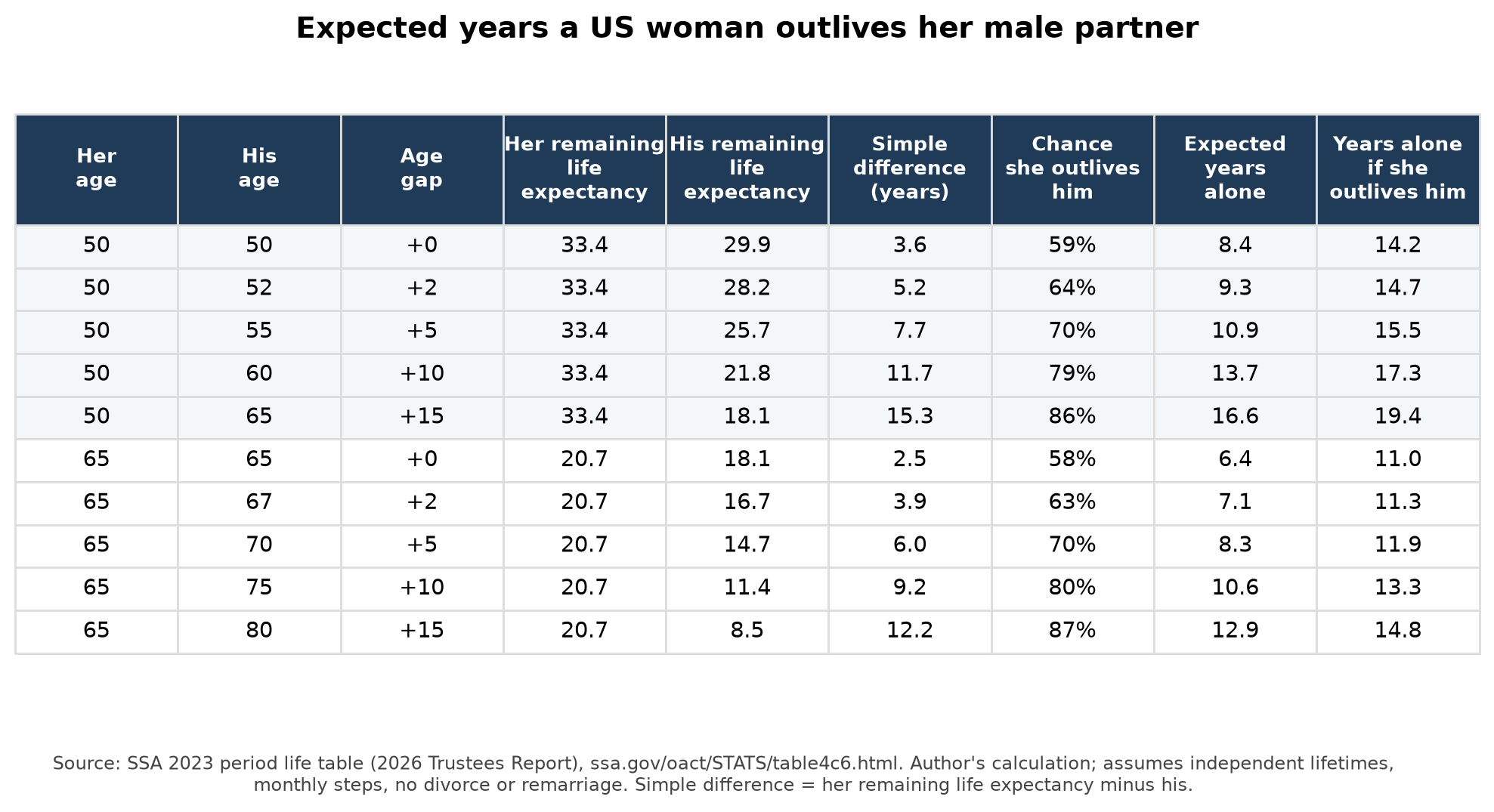
The honest part about this model: a period life table assumes today’s death rates continue, and spouses share diet, income and habits, which correlates their lifetimes and would shrink the gaps somewhat. On the other hand, the model ignores the widowhood effect, the cardiovascular spike after bereavement and the higher late-life morbidity of women, all of which make those years harder. The direction of the result is robust. On average, a 65-year-old woman married to a man of the same age or slightly older can expect six to seven years of widowhood, and the women who do outlive their husbands spend about 11 to 12 years alone, with more if he is older. Interestingly, the widowhood meta-analysis I cited above found that the excess mortality after bereavement was significant for men (RR 1.23) and close to null for women (RR 1.04). Women appear to be more resilient after the loss, and they experience it far more often.
This is what I mean by longevity inequality. The same biology that gives women more years also makes it likely that many of those years are spent without the person they planned to grow old with, while men are more likely to die first and leave a partner behind. The UN World Population Prospects 2024 projects that future gains in life expectancy will be higher for males than for females at similar levels of life expectancy, so the gap should narrow slowly. In my view that narrowing will take decades, and every couple alive today lives with the current gap.
Why longevity biotech is the fix
Social policy can help widows with pensions, housing and care, and it should. But the core of the problem is biological: men die earlier, and women live longer while carrying more morbidity late in life, the mortality-morbidity paradox described by Austad and Fischer. In my view, the intervention that addresses both sides of this equation is to slow, stop or reverse the aging process itself, in both sexes, and extend the time people spend near peak function.
That means dual-purpose therapeutics that treat a major disease and target aging at the same time, aging clocks that can measure whether an intervention is working within the timeframe of a clinical trial, and longevity studies that include both sexes from the start. It also means taking female aging seriously as its own biology. One recent example is a review in Aging and Disease that proposes that perimenopausal hormone replacement therapy may constitute an early-stage geroprotective intervention when started within 10 years of menopause onset in clinically eligible women, and calls for prospective, biomarker-driven studies to test that idea. Another is our standardized protocol for mouse longevity studies in preclinical drug development, designed with Richard Miller and others to make lifespan data a routine part of drug development. If we can compress male excess mortality and extend female healthy life, couples may get more years together, and the years at the end may be better ones.
My story
Now the personal part, in my own words.
For the first time in my life I am madly in love. I was in love once before; it was beautiful, but then it crashed because of my work. Now, my partner is even more focused on longevity and she took a bet on my despite a significant age gap. I must be massively focused on longevity to fix the longevity inequality in order to make this relationship fair. For us to be together, we really need to deliver on the promise of longevity biotechnology.
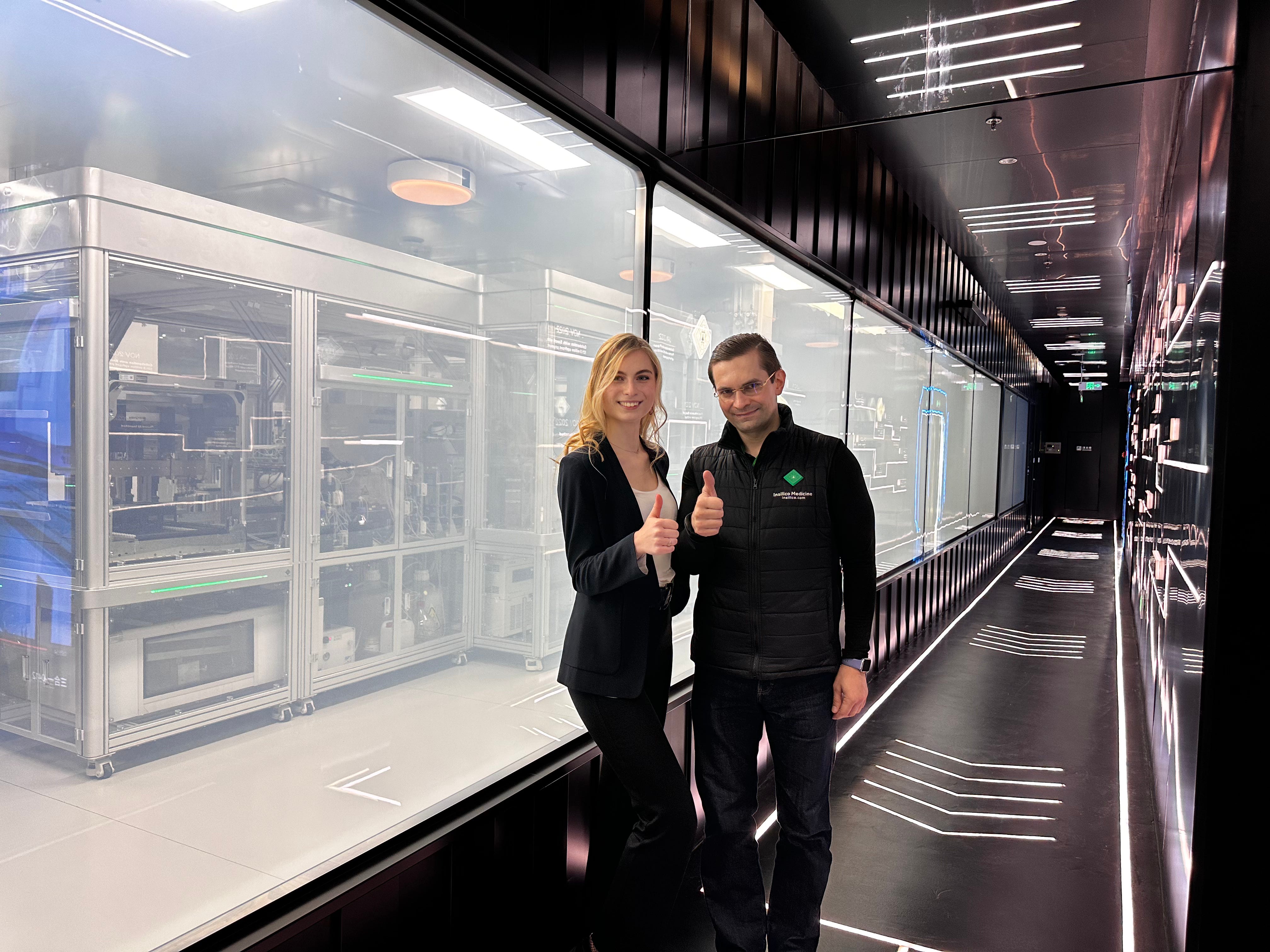
My fiancée is Dominika Wilczok, and she is an absolute genius. She has already published multiple papers and is an Entrepreneur in Residence at Qiming Venture Partners, working in longevity, a role she announced in July 2026. She is more brilliant than I am, and I am happy to put all my capabilities to work to help her advance her goals and career in longevity and other impactful areas of science, working on technologies our civilization must have.
When I wrote my longevity pledge, I said I would not marry until I met someone as dedicated to the cause as I am. Dominika is that person.
Purpose, together
If there is one lesson from the data in this post, it is that the people who live longest tend to have both someone to live with and something to live for. Purpose shows up in mortality curves, in dementia risk and in the cognitive trajectories of people in their 80s. Relationships show up in survival meta-analyses, in the cardiology of grief and in the epigenetic clocks. For couples who share a mission, the two reinforce each other: your partner becomes part of your purpose, and your purpose becomes something you build together.
I am also glad to see others in our field on a similar journey. David Sinclair and Serena Poon, for example, co-founded Fully Aligned Co. in 2022 and have hosted joint longevity shows, and I wish them every success on their journey together.
So here is my call. We need more longevity couples: scientists, physicians, engineers, investors and entrepreneurs who fall in love with each other and with the problem of aging. Couples who understand the hours this work takes, and for whom closing the longevity gap between them is a personal goal as much as a scientific one. If you are one of them, I would love to hear your story. And if you are working on technologies that can give couples more healthy years together, please reach out.
With love from the longevity front lines,
Alex