


A new report landed in my inbox this week — “The Longevity Money Map” from Unfiltered. Sixty-six pages covering investment trends, scientific bets, and a ranked list of the 100 most powerful figures shaping the longevity sector in 2026. They scored people across five weighted criteria: capital power (25%), scientific credibility (20%), strategic influence (20%), original impact (20%), and public profile (15%). Capital at the top. Profile at the bottom. That alone tells you something about the editorial judgement.
I do not usually comment on power lists. Most of them are popularity contests dressed up as analysis. But this list tries to combine power (80%) and scientific credibility (20%). So let me walk through the top 20 and what it tells us about the state of the field.
The Top 20
#1 — Hal Barron, CEO, Altos Labs. The operating brain behind the largest single bet in longevity history. Altos exists because Bezos wrote a cheque and Klausner brought the science, but it is Barron who is turning cellular reprogramming from a research thesis into a clinical programme. The hire of Joan Mannick as CMO in August 2025 signalled the translational shift. Everything downstream follows from the infrastructure Barron is building.
#2 — Mehmood Khan, CEO, Hevolution Foundation. Up to a billion dollars a year committed to slow human ageing. Four hundred million already deployed. Khan reframed the field’s vocabulary from longevity to healthspan and got the change to stick. PepsiCo CSO, Takeda Global R&D President, now chair of Life Biosciences — the company running the first FDA-cleared human partial-reprogramming trial. No one else in the field holds sovereign capital, Big Pharma experience, and frontier clinical science in a single seat.
#3 — Vinod Khosla, Founder, Khosla Ventures. Most longevity investors place one big bet. Khosla has placed ten. NewLimit. Loyal. Rejuvenation Technologies. Rubedo. Circulate Health. Tomorrow Bio. The thesis is pattern-betting: the future of ageing biology is unknowable, so back enough credible attempts that one or two land. Where Bezos and Altman each wrote one historic cheque, Khosla wrote ten that will collectively decide what the next five years of longevity look like.
#4 — Bob Nelsen, Co-founder, ARCH Venture Partners. ARCH anchored Altos — leading the largest biotech round ever raised. Fund XIII closed at $3 billion. Most VCs who write large biotech cheques are following someone else’s conviction. Nelsen’s cheques tend to be the conviction other people then follow. The reason Altos exists is partly because Nelsen decided it should.
#5 — Demis Hassabis, CEO, Isomorphic Labs. Not a longevity figure in the traditional sense. The reason the next decade of longevity drugs will exist. AlphaFold — the protein-structure model that won him the 2024 Nobel in Chemistry — now sits underneath every serious AI drug discovery effort in the world. Isomorphic signed deals worth nearly $3 billion with Lilly and Novartis across 2025 and 2026. Targets that were undruggable a decade ago are now in active design.
#6 — George Church, Co-founder, Rejuvenate Bio. More than fifty biotech companies co-founded. Rejuvenate Bio published mouse partial-reprogramming lifespan data in February 2026 — among the strongest preclinical results of the year. The Harvard geneticist sits at the centre of a network of researchers, founders, and capital that has shaped genomic biotech for two decades.
#7 — Shinya Yamanaka, Senior Investigator, Gladstone Institutes. He found the four reprogramming factors in 2006. Without that discovery, none of the reprogramming companies on this list would exist. Altos, Retro, NewLimit, Life Biosciences — all downstream of his 2012 Nobel-winning induced pluripotent stem cell work. The field’s intellectual centre of gravity has been the same person for two decades.
#8 — Sam Altman, CEO, OpenAI. Personally funded Retro Biosciences’ entire $180 million seed round, then led its Series A at a reported $5 billion valuation in 2025. The OpenAI-Retro reprogramming collaboration produced a protein-engineering result claiming a fiftyfold increase in reprogramming-marker expression in August 2025. The rare investor whose individual conviction created a top-tier longevity company from scratch, and whose AI infrastructure now actively shapes its science.
#9 — Rick Klausner, Chief Scientist, Altos Labs. Former NCI director. Co-founder of Juno Therapeutics and Grail. Arguably the most respected translational oncologist of his generation. His decision to run Altos’s scientific programme was the signal that turned cellular reprogramming from venture optimism into institutional biotech. Scientific brain to Barron’s operating one.
#10 — David Ricks, CEO, Eli Lilly. Turned GLP-1s into the most consequential real-world healthspan intervention of the decade. The $2.75 billion Insilico Medicine partnership in March 2026 is the largest AI-pharma longevity-adjacent deal of the cycle. Lilly’s TuneLab platform now gives early-stage biotechs federated access to its drug discovery models. No other big-pharma CEO has done more to bring ageing-adjacent science into mainstream medicine.
#11 — Alex Zhavoronkov, CEO, Insilico Medicine. Hong Kong listing in late 2025. The Lilly partnership followed in March 2026. Twenty-two AI-designed preclinical candidates in pipeline. Unfiltered’s assessment: “Insilico has stopped being a story about AI drug discovery and become one about industrialisation.”
#12 — Jeff Bezos. One cheque, written in 2022, that turned cellular reprogramming into an institutional category overnight. Nothing visible since. The Altos cap table still legitimises every reprogramming bet that followed it. He is on this list for what he did four years ago. That is how large the gravitational effect of a single decision can be.
#13 — Joe Betts-LaCroix, CEO, Retro Biosciences. From Altman’s $180 million seed to a $5 billion valuation in 2025. Retro’s autophagy-boosting Alzheimer’s pill went into first-in-human testing in December. The company is no longer a bet on the founder. It is a bet on the science.
#14 — Noubar Afeyan, Founder, Flagship Pioneering. Sits on the Altos board. Seeded Moderna. The 2025 launch of Lila Sciences with $200 million extends the AI-biology thesis into a fresh vehicle. Capital weight and boardroom reach across longevity-adjacent biotech, deployed without theatre.
#15 — Laura Deming and Alex Colville, Founders, age1. The Longevity Fund, founded by Deming in 2011, was the field’s original specialist VC. Now rebranded as age1. Led Loyal’s $100 million Series C in February 2026. The franchise has outlasted three cycles of fashion in the category.
#16 — Lars Fruergaard Jorgensen, CEO, Novo Nordisk. Runs the company whose semaglutide success funds Novo Holdings’ longevity portfolio and reset the metabolic-health investment thesis. The Novo balance sheet now decides which adjacent bets get capital.
#17 — Arthur Levinson, Founder, Calico. Founded Calico in 2013 with Alphabet’s backing. The eleven-year AbbVie partnership ended in November 2025. Roughly a hundred layoffs followed. Twenty-plus programmes still running, Alphabet money still committed. The question is whether Calico still matters.
#18 — Mike Curtis. Shepherding the first-in-human gene-edited porcine kidney trials. Recipients achieved significant periods of dialysis independence by early 2026 — a threshold that quietly reframes the global organ shortage.
#19 — Martine Rothblatt, CEO, United Therapeutics. Built an $18 billion market-cap public company around extending human life. Landmark porcine-to-human cardiac and kidney graft results in 2025 and 2026. Xenotransplantation is no longer speculative. It is investable.
#20 — Kimberly Powell, NVIDIA. Almost every AI drug discovery company on this list runs on hardware she oversees. The 2026 push into agentic AI for clinical workflows is shifting pharma from documentation to autonomous R&D — on her chips.
What About The Real Power Brokers?
To be honest, I found this list to be a little bit strange. I’ve been in the longevity biotechnology industry for over 20 years and founded the ARDD conference, the most elite event in longevity biotechnology bringing together pharma, large credible investors, absolutely top academics, policy makers, and many startups. It is not easy to get a speaker slot at this event. If you were to ask me to rank people and companies using the same criteria as Unfiltered, one of the absolute top people would be Peter Diamandis. He helped start many longevity and impactful high-tech ventures. He also has massive following. I was also surprised to see David Sinclair at the very bottom of the list. David is the “face of longevity biotechnology”. Highly-cited prof at Harvard with massive following and multiple attempts at commercialization and industrialization.
The LLM Jury: A Different Kind of Consensus
Unfiltered’s list is one editorial team’s weighted judgement. It is well-constructed but it is still one lens. There is another approach to ranking that removes the editorial entirely: ask the machines.
At AgingBio.com, we run what we call a Multi-Model Consensus Index. The method: take six frontier LLMs — GPT-5.5, Claude Opus 4.7, Claude Sonnet 4.6, DeepSeek V4 Flash, Kimi K2.5, Kimi K2.6 — ask each the same prompt (”List the top 20 scientists in longevity biotechnology. Rank them 1-20 with a brief reason for each. Give a direct answer. No hedging.”), score inversely (rank #1 = 20 points, #2 = 19, and so on), and aggregate. Maximum possible score: 120.
Unfiltered measured power — capital, influence, profile. The LLM jury measures something else entirely: scientific contribution, as reflected in the sum total of published knowledge. No investment positions. No editorial dinners. No LinkedIn visibility. Just six independently-trained models from four different companies reading the same literature and converging.
Here is what they returned:
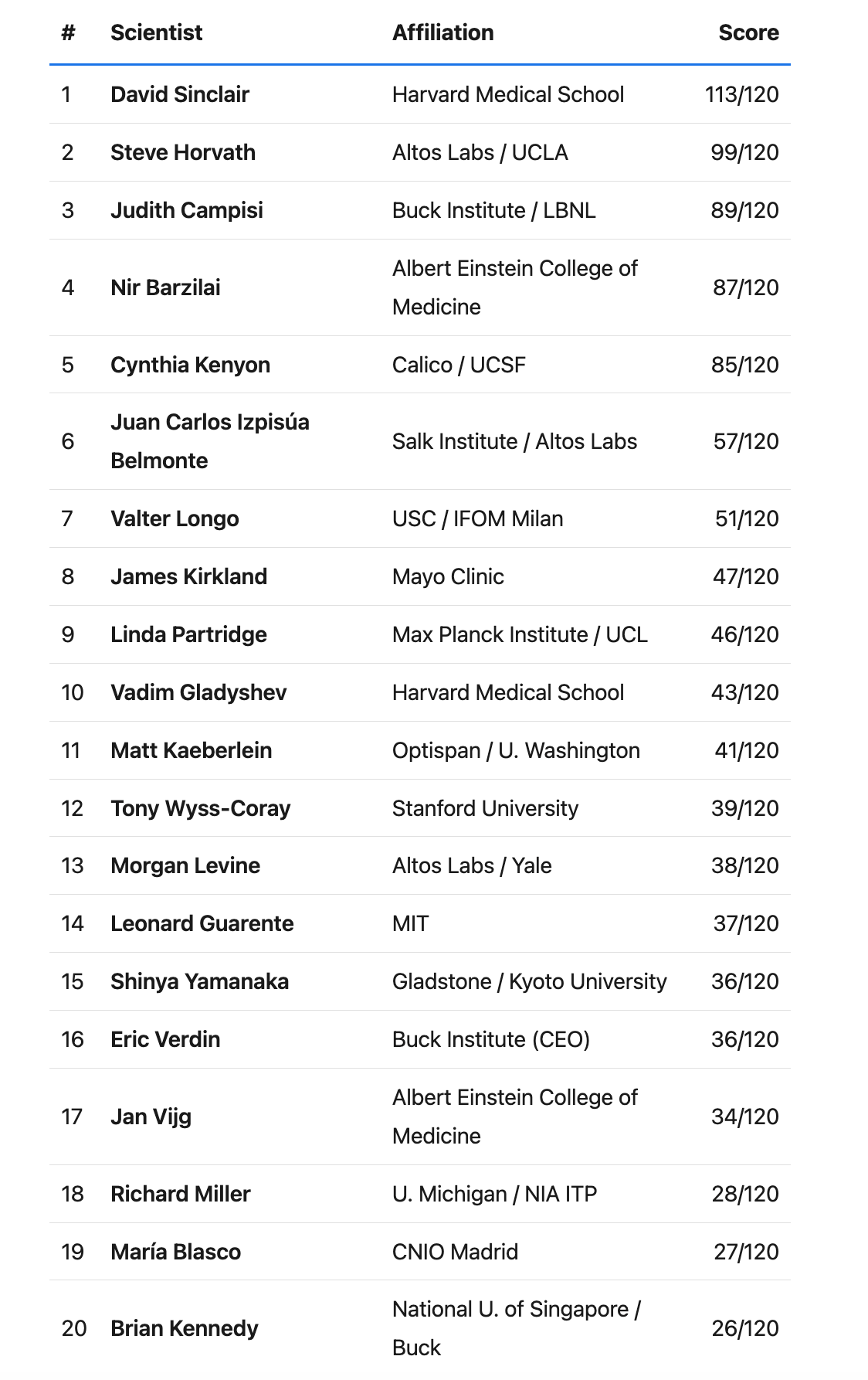
Three things jump out immediately.
First, the top five are not close. Sinclair at 113, Horvath at 99, Campisi at 89, Barzilai at 87, Kenyon at 85 — then a cliff to Izpisúa Belmonte at 57. The models agree overwhelmingly on who the founding figures of modern longevity science are. The gap between the top tier and everyone else is not a matter of editorial taste. It reflects decades of citation weight, mechanistic discoveries, and translational impact that the models can actually quantify.
Second, the list is almost entirely basic scientists. No CEOs. No investors. No capital allocators. When you strip away the money question and ask purely who has moved the science forward, the answer looks nothing like Unfiltered’s top 20. The two lists share only three names in common — Sinclair, Yamanaka, and arguably Belmonte through his Altos connection. Power and contribution are measuring different things.
Third, Sinclair’s placement is instructive. Unfiltered ranked him 92nd — below the CEO of Whoop — because their methodology weights capital control at 25% and he controls none. The LLM jury ranks him first at 113/120 because his citation footprint, mechanism discoveries (sirtuins, NAD+, ICE mice, OSK reprogramming), and influence on downstream research programmes are simply larger than anyone else’s. Five of six models ranked him in their top two. The models do not care about his Twitter presence or his supplement company. They care about what the scientific record says. And the scientific record is unambiguous.
Is the LLM jury perfect? No. It has training cutoffs. It can reflect biases in media coverage of certain scientists over others. Campisi’s placement at #3 despite her passing in 2024 shows the models weigh lifetime contribution rather than current activity. But when six independently-trained models from four different companies converge this strongly, that convergence is meaningful. It is harder to dismiss than any single journalist’s or editor’s opinion. It is a form of consensus that did not exist two years ago.
The Unfiltered list and the LLM consensus index are measuring complementary things. Unfiltered maps power — who decides where money flows. The LLM jury maps contribution — who has actually moved the science forward based on the weight of evidence. Both are useful. Together, they give you a more complete picture than either alone.
What the List Tells Us
Three patterns emerge from the Unfiltered top 20.
First, the capital hierarchy is clear. Seven of the top 10 are investors or CEOs controlling capital allocation, not scientists. Capital gates everything else. In a field that burned through decades of academic enthusiasm without producing an approved drug, the constraint was never ideas.
Second, AI drug discovery is now embedded in the power structure. Hassabis at #5. Zhavoronkov at #11. Koller at #24. This is not a separate category anymore. The people building AI tools for drug discovery are ranked alongside the people running the largest pharma companies and writing the largest cheques. T
Third, reprogramming dominates the scientific bets. Altos (#1, #9), Yamanaka (#7), Church (#6), Retro (#8, #13), NewLimit, Life Biosciences — the field’s centre of gravity has shifted decisively toward partial cellular reprogramming. The first human trial starts in 2026. Whether it works or not, the institutional capital is already committed.
Where This Goes
Unfiltered plans quarterly updates. The interesting question is not who is on the list today. It is who moves up — and who disappears — over the next two years as clinical data starts arriving.
Power lists are often about attention. This one is about money and power. The LLM consensus is about contribution and evidence. Use both. Trust neither completely. The field is moving too fast for any snapshot to stay accurate for long.
The full Unfiltered report is available at reports.unfilteredonline.com/longevity
LLM Report: www.AgingBio.com
I believe that in the longevity industry, Shaf Keshavjee will play the leading role over the next five years. He is the founder of the first medical center for organ repair in Toronto and the most renowned specialist in the restoration and preservation of isolated organs. These technologies will revolutionize the entire medical industry, making surgeries cheaper and transforming transplantation — because doctors will begin transplanting patients’ own organs after they have been restored. Accordingly, the main breakthroughs in increasing both average and maximum life expectancy of patients — that is, in longevity — will come from this direction.
Absolutely love this, Alex! The Longevity Top 100 is a game changer for understanding who's really making waves in the field. Excited to see how AI, robotics, and other innovations will shape our future. Let’s keep pushing the boundaries!