

Many of us remember the 10 years of progress in AI from 2012 to 2022. Many great feats of capability demonstrations from image recognition in ImageNet, Atari Games, image generation using GANs, AlphaGo, molecular generation using GENTRL, the transformer moment, BERT, and many others. Every time, these proofs of concept made headlines but it was the launch of ChatGPT in November 2022 that started the hyperinvestment and mass adoption of modern generative AI.
I think longevity biotechnology had its version of that moment October 1-3 in Boston. For years, we have been talking about aging clocks as tools to measure the effects of therapeutics in real clinical trials. For 13 years since its founding, every year we came closer to this goal.
At ARDD 2026, for the first time, three companies stood up and showed clinical data in which a drug was associated with lower biological age from real clinical trials. Each used a different kind of aging clock. Two of them are the largest metabolic-drug makers on the planet. The third is my own company, so take my enthusiasm with the appropriate grain of salt and proper disclaimers; I’ll give you the caveats too. None of these results conclusively proved that a drug reverses human aging. Together, though, they mark the point where “aging clocks in clinical trials” stopped being a pitch slide and became something pharma does with its own trial samples. These studies developed a framework for how longevity therapeutics may be discovered. Two of these studies strengthened the hypothesis that incretin drugs such as tirzepatide and semaglutide may be the first true longevity therapeutics.
How a Basel side session became the largest pharma longevity meeting
I started ARDD (Aging Research and Drug Discovery, agingpharma.org) 13 years ago in Basel with Bhupinder Bhullar, then at Novartis. It ran as a small forum inside MipTec and Basel Life Science Week. The first edition was billed as an international symposium on geroprotectors. Brian Kennedy joined as co-organizer in 2016, and Morten Scheibye-Knudsen in 2017.
From 2020 to 2025 the University of Copenhagen hosted ARDD. Over those six years (it went hybrid during COVID but remained open and on-site setting the new standard for scientific conferences) it became the biggest annual gathering where academic geroscience, biotech, pharma and investors met in one hall.
Then in March 2026, the University of Copenhagen decided it could not host the conference in its current form. Morten announced on LinkedIn that ARDD 2026 in Copenhagen was canceled. Within hours, after conversations with Vadim Gladyshev and Jesse Poganik at Harvard Medical School, we announced that ARDD would go ahead in Boston (Longevity.Technology). It would be shorter and more focused on pharma and biotech, with Insilico Medicine as official organizer, Vadim as Executive Chair, Jesse as Co-Chair, and Morten and Daniela Bakula staying on as co-chairs.
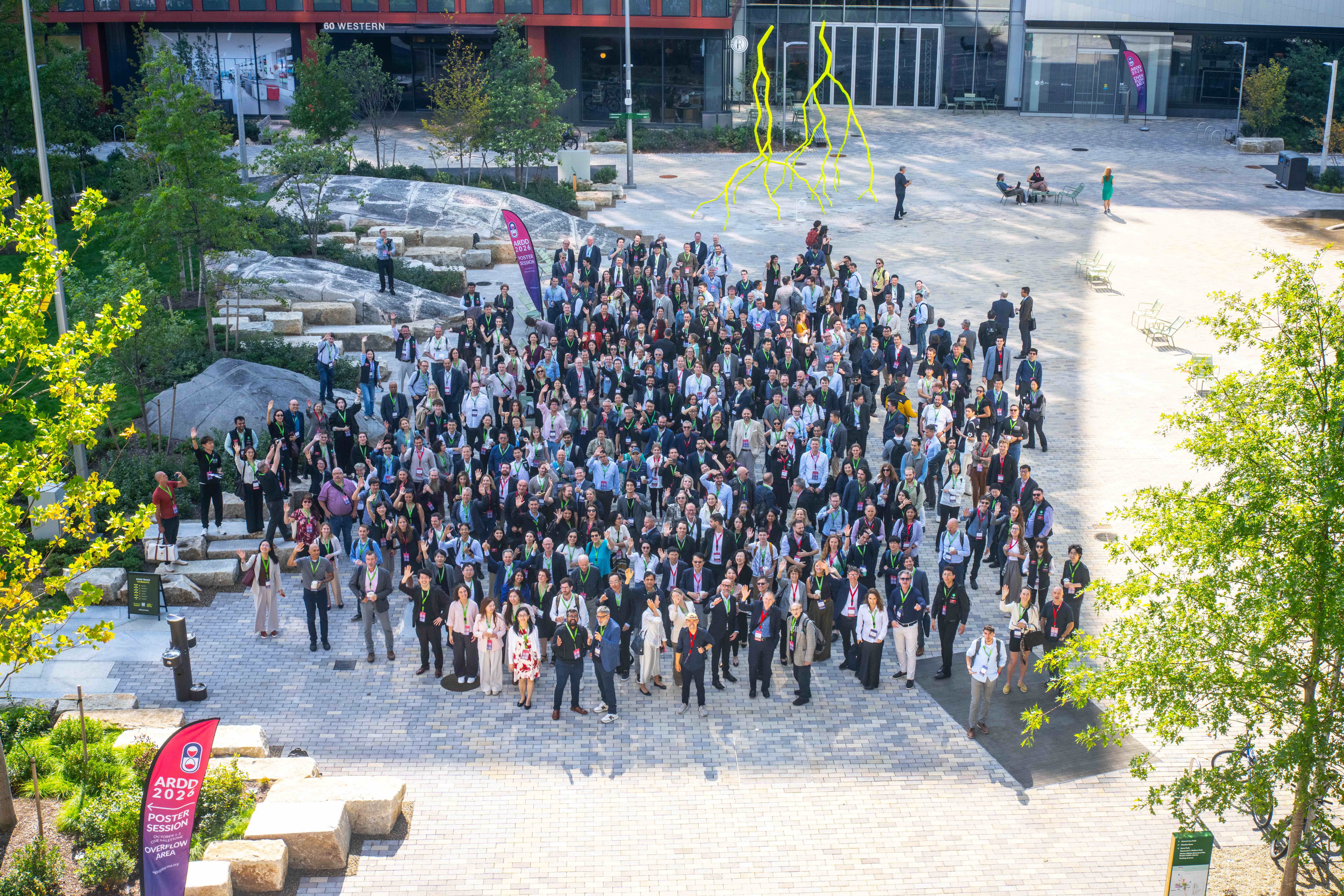
The 13th ARDD took place October 1 to 3, 2026, at Harvard’s David Rubenstein Treehouse in Allston, with posters and overflow at One Milestone next door. As Phil Newman put it in his Reflections piece, the move happened out of necessity, but it put the meeting in the middle of the world’s densest cluster of aging research.
Disclosure, since it matters for what follows: Insilico organizes ARDD, and Eli Lilly was a Tier 1 sponsor of ARDD 2026. Novo Nordisk was also a significant sponsor.
The runway: Lilly in 2024, Lilly and Novo in 2025
ARDD 2024 (Copenhagen, August 26 to 30). Eli Lilly was on the program for the first time in such a profound way. Dr. Andrew Adams, Group Vice President of Molecule Discovery and Director of Genetic Medicines at Lilly, gave a main-track talk titled “Can genetic medicine give us a world without disease” (video). Lilly’s Jonathan Wilson sat on the pharma panel on sourcing early-stage aging innovation. Longevity.Technology listed Lilly among the pharma companies giving the meeting its strongest industry presence yet (LT), and Jens Juul Holst (University of Copenhagen) asked on the main track whether GLP-1 receptor agonists could ease the metabolic complications of aging. In the Q&A after Adams’s talk, someone asked whether Lilly would pivot toward longevity with its GLP-1/GIP franchise. Dr. Adams said that, at least for a while, Lilly would focus on specific outcome-based measures rather than a broad “longevity” claim. That was the right answer for 2024. Keep it in mind for what follows.
ARDD 2025 (Copenhagen, August 25 to 29). This was the year the vocabulary changed. As Longevity.Technology reported, Andrew Adams asked the room whether GLP-1s might be the world’s first longevity drugs. The next day Novo Nordisk’s Lotte Bjerre Knudsen, whose program talk was “Organ Protection with GLP-1 Receptor Agonists”, put up a title slide that read “Semaglutide as a proven longevity medicine.” Lilly’s Berthil Clasen joined our pharma panel, “How do we advance longevity in pharma in a credible way?”, moderated by the FT’s Clive Cookson.
At the time I wrote that in under 24 hours the two biggest biopharma companies had presented their diabetes and obesity blockbusters as the world’s first recognized longevity therapeutics. Still, 2025 was a change of language. The obvious question was: where is the aging data?
So here are the three big reveals:
Reveal #1: Lilly, tirzepatide and epigenetic clocks
Kevin Duffin, VP of Aging Research at Eli Lilly (Oct 2). The fact that Lilly now has a VP of Aging Research is itself part of the story.
Lilly ran an epigenetic sub-study inside SURMOUNT-5, its head-to-head trial of tirzepatide against semaglutide. It took paired whole-blood samples from the tirzepatide arm at baseline and at week 72, which works out to 1.38 years of elapsed time. Zymo Research and TruDiagnostic each generated methylation data independently, so the two datasets could be checked against each other. According to Longevity.Technology’s write-up, 71 subjects had paired samples after quality control.
The signal:
All 15 age-unit epigenetic clocks showed less aging than the 1.38 years that had actually passed. Two reached statistical significance.
Per the ARDD recap, first-generation clocks showed roughly a 0.5-year reduction and second-generation clocks more than 1.5 years. Pace-of-aging clocks slowed; DunedinPACE fell from a median of 1.13 to 1.08 in the Zymo data.
Organ-specific methylation clocks pointed to lower heart, immune, kidney and liver age.
As Duffin said at the meeting (MIT Technology Review, and it was super cool to see the great Antonio Regalado in the audience at the conference): “All the clocks are telling a consistent story that we’re seeing a reduction in age… It’s not like we’re going to reverse age by 30 years or something, but it’s a significant reduction.”
The honest part: Lilly gave this talk with heavy caveats, and I respect that. Duffin called the findings hypothesis-generating, and Lilly plans to extend the work to other weight-management studies.
Clock type: epigenetic (DNA methylation), first through third generation plus organ clocks. Poster #13 showed the proteomic aging clock data (I hope to share it sometime).
Reveal #2: Novo Nordisk, semaglutide and proteomic organ clocks
Nikolaj Kulahin Roed, Global Project Leader (Oct 1), and Alejandro Aguayo-Orozco, Senior Scientific Director, Diabetes Insights (Oct 3). Alejandro Aguayo-Orozco was the real “first” for the ARDD, the first time the pharma giant presented a massive unpublished study (currently in review and I encourage the editors to accelerate the publication, the community has massive need for it).
This was the biggest dataset of the meeting. MIT Technology Review reports that Novo drew blood from 10,052 people, half on drug and half on placebo, at baseline and months later, and ran the samples through proteomic clocks that predict age and mortality risk.
The signal:
Roed: biological age was lower by about “two to three years” “across trials and across different tissues,” with onset at 13 to 20 weeks. Longevity.Technology reports the effect was sustained or larger out to 150 weeks.
Aguayo-Orozco: organ age falls over time, by as much as ~4 years for a clock built on heart proteins. “I think it’s pretty clear that the organ age is shifting,” he said (MIT Technology Review). Heart and kidney age dropped from the first timepoint, and the effect spread to more organs over time.
Per the recap, the organ-age reductions were not mediated by weight, HbA1c or hsCRP. It is possible that the heart-age reduction mediated up to 40% of the reduction in cardiovascular death.
Aguayo-Orozco framed it this way: “When you intervene with semaglutide, does it actually move the clocks in any direction? And the answer is yes.” When I asked him on stage whether a reasonable person should start taking semaglutide, he gave the only answer a pharma scientist can: “I am not a physician. I cannot answer that question.”
Clock type: proteomic, including organ-specific clocks. Vadim Gladyshev’s lab helped Novo with the molecular measurements.
Reveal #3: Insilico, peripherally-restricted TNIK inhibitor rentosertib and proteomic clocks in a non-metabolic drug
Me, Alex Zhavoronkov, (main stage, Oct 2). (The day before, Michael Li of Harvard Business School presented an HBS case on our rentosertib decision.)
Rentosertib is an AI-discovered inhibitor of TNIK, a kinase we first flagged as a target linked to several hallmarks of aging. We are developing it for idiopathic pulmonary fibrosis (IPF), a progressive fibrotic lung disease that is strongly associated with age. The randomized, placebo-controlled Phase 2a (NCT05938920; 71 patients at 21 sites in China, randomized to 30 mg once daily, 30 mg twice daily, 60 mg once daily or placebo) was published in Nature Medicine on June 3, 2025 (Xu et al., Nat. Med. 31, 2602 to 2610). In the 60 mg once-daily arm, FVC rose by about 98 mL over 12 weeks. That was a small study, and I made no definitive claims.
What matters for longevity is what happened next. We collected serum at baseline and at weeks 2, 4 and 12 of that Phase 2a, and 42 of the participants consented to proteomic profiling (Olink Explore 3072). In a Nature Biotechnology paper published September 7, 2026, written with Vadim Gladyshev’s group and others, we compared six proteomic aging clocks (ProtAge, OrganAge mortality, OrganAge chrono, PAC, ipfP3GPT and PAOPAC) head to head. All six predicted lower biological age in the treated arms, while the placebo group showed minimal change or slight increases (Zhavoronkov et al., 2026).
The effect peaked at week 4. Of 54 treatment-versus-placebo comparisons in total (6 clocks, 3 timepoints, 3 regimens), 21 reached significance, and 11 of the 18 week-4 comparisons did. In the 60 mg once-daily arm, all four chronological clocks showed a significant reduction at week 4 of 2.71 to 3.46 years (paper). The 30 mg twice-daily arm gave the broadest agreement across clocks, and the consensus plot I showed at ARDD put its week-4 reduction at up to about 6 years (my ARDD 2026 slides). So “3 to 6 years at week 4” is a fair summary, with the caveat that the low end comes from one arm and the high end from the consensus plot of another. Between weeks 4 and 12 the signal plateaued.
The mortality-based organ clocks added detail. The artery clock showed significantly lower predicted age at every timepoint in every treated arm, from 6.95 to 16.57 years; the largest value (16.57 years) was in the 60 mg once-daily arm at week 12. Brain (up to 8.5 years, 30 mg once daily, week 4), pancreas (up to 6.6 years), immune system (up to 5.56 years) and stomach (up to 1.73 years) clocks also moved in select arms (paper; my ARDD slides). Organ-specific chronological clocks showed no significant shifts.
Status: Phase 3 was initiated in July 2026 (EurekAlert). The plan is 320 patients over 52 weeks.
Why this matters: Rentosertib does not belong to the GLP-1 class and does not cause weight loss. It is an anti-fibrotic small molecule designed from the start for “dual purpose”: win approval in a disease where we can beat standard of care, while measuring aging along the way. Per the ARDD recap, about 70% of Insilico’s programs are now designed this way, pick a target using aging research, repurpose into several indications via “pipeline-in-a-product” model and then, potentially expand into aging.
The honest part: The paper says it directly: more work needs to be done on everything but also on separating aging from disease. Our pathway analyses suggest senescence and metabolic shifts alongside the anti-fibrotic effect, but that evidence is indirect. These were 42 IPF patients over 12 weeks, with roughly 9 to 11 per arm in the proteomic analysis, and we have no data yet in healthy people. Interestingly, the arm with the best FVC response (60 mg once daily) was not the arm with the most consistent clock response (30 mg twice daily), and change in FVC explained little of the change in biological age (median R² = 0.06), which argues somewhat against a pure disease-improvement explanation (paper).
Clock type: six proteomic clocks (four chronological, two mortality-trained), inside a randomized, placebo-controlled trial of a non-metabolic drug.
Why I call this the ChatGPT moment
Three companies, three drugs, two mechanisms (incretin and anti-fibrotic), two measurement layers (DNA methylation and plasma proteins), more than 20 clocks. All pointed the same way.
That is the point. For a decade, the honest criticism of aging clocks was that they were a solution looking for a trial. As Yuge Ji told MIT TR: “The clock people have been pushing for a decade to get this kind of study done. It’s huge for them.”
Three things changed this month:
The data source changed. These results come from sponsor-run clinical trials with real drugs. Observational cohorts are no longer the only source.
The speakers changed. The two largest metabolic-drug companies in the world put aging-clock readouts on a conference stage under their own names.
The audience changed. FDA’s Chief Scientist, Steven Kozlowski, told the room that aging and longevity will be a priority in FDA’s upcoming regulatory science focus areas, with new trial guidance planned for early FY2027 (GEN; Lifespan.io). Fittingly, he noted that the last version of that document came out “a few months before ChatGPT went online.”
Steve Horvath, who more or less invented the field of epigenetic clocks, told MIT TR: “Two years is a pretty strong effect, in my book.” He added that the emerging data could provide “evidence that these GLP-1 drugs are actually what is known as geroprotectors.”
(Full disclosure: as I said on stage and MIT TR reported, I am on tirzepatide and am “an equal-opportunity injector of semaglutide as well.” That’s an n of 1. It is neither data nor advice.)
ARDD 2026 in three days: the takeaways
The full talk-by-talk summaries are on the ARDD 2026 Daily Recap. Here is the short version.
Day 1 (Oct 1): rigor, regulators and real money
Starting with a hype warning. Harvard Medical School Dean George Daley opened by telling us to listen “skeptically and critically.” He warned that optimistic longevity claims often outrun the science, and cited a recent death after an anti-aging NAD infusion. It was a good way to open (LT).
Government showed up. HHS Assistant Secretary for Health ADM Brian Christine gave the policy address. On the FDA panel, Kozlowski put aging on the regulatory-science agenda and Jeffrey Siegel outlined two approval routes: benefit across two or three age-related diseases, or a composite functional indication. Penzenstadler: “We’re the umpire and not the coach… You guys work out the cookbook” (BI).
ARPA-H ProSPR (up to $144M over five years) is building a regulatory-grade intrinsic capacity score.
The HBS case on rentosertib: license out or develop in-house? (We kept it.)
XPRIZE Healthspan announced its top 20 finalists; 10 teams were awarded a share of $10M to run one-year trials.
Day 2 (Oct 2): pharma takes the main stage
Novartis’s Fiona Marshall gave the keynote. Single-target regenerative approaches (LNA043, bimagrumab) moved tissue but not function, so Novartis is shifting to systems biology built on longitudinal human data (LT interview).
Pharma CEO panel (moderated by TIME’s Alice Park) with Takeda’s former CEO Christophe Weber, Menarini’s Elcin Barker Ergun, Marshall, Pfizer’s Ariel Feldstein and Moderna’s Stéphane Bancel. The consensus: prevention and multi-system mechanisms, with trial timelines, endpoints and reimbursement as the barriers. Elcin noted that Menarini licensed two cancer molecules from Insilico’s AI platform, both now in clinical trials.
My talk: rentosertib (+98 mL FVC, six clocks, up to about 6 years lower biological age at week 4, Phase 3 under way) and the dual-purpose strategy.
Lilly’s tirzepatide clocks (Duffin), plus TruDiagnostic’s deeper dive into the methylation data.
George Church on multi-gene therapies; Tony Wyss-Coray on plasma proteomics that age individual cell types (old astrocytes were the strongest cellular predictor of Alzheimer’s).
Investor panels: treat aging drugs as drugs, don’t overpromise, and watch China. Qiming’s Kan Chen called GLP-1s the “first longevity medicine” that isn’t “snake oil.”
AI in Drug Discovery Forum: proprietary, human-relevant data is the moat; AI alone is not. Our 25,000-prompt benchmark found smaller fine-tuned models beating frontier LLMs on drug-discovery tasks.
Day 3 (Oct 3): therapeutics, deals, dogs and virtual cells
Vadim Gladyshev argued for modeling aging as systemic biological states, using clocks across eight data modalities. In mice, 5 of 10 compounds advanced from an in-silico screen extended lifespan (work under review).
AstraZeneca’s Mark Cobbold showed that knocking out CDKN2A, CDKN2B and MTAP stops T-cell senescence, which could enable off-the-shelf CAR-T at very large scale. He called aging the “mother of all diseases.”
Licensing panels: big upfronts go to validated biology, and translation confidence is the main barrier for longevity assets.
David Sinclair on NAD and PARP14, OSK, and SL100 (unpublished progeroid-mouse lifespan data). Life Biosciences’ ER-100 partial-reprogramming therapy is in Phase 1.
Pet & Animal Longevity Forum: the Dog Aging Project has enrolled more than 55,000 dogs since 2020. Horvath made the case for methylation clocks as surrogate endpoints in veterinary trials.
Virtual Cell in Time Forum: Insilico launched its Virtual Aging Cell, a multi-agent system with about 43 agents per layer across five biological scales, now in prospective lab validation.
Five takeaways
Aging-clock readouts are now in sponsor-run trials, and they agree with each other.
The FDA is engaged and wants the field to bring a pre-competitive “cookbook” of biomarkers.
The route to market runs through disease approvals first, with aging benefits built on top. GLP-1s and rentosertib follow the same playbook.
Capital is available for de-risked, indication-anchored assets. Vague longevity platforms struggle to raise.
The next big question is healthy people, and controlled trials are starting to answer it.
Resources
Official ARDD 2026
Daily Recap (talk-by-talk summaries): https://agingpharma.org/2026/recap
Official photos: https://agingpharma.org/photos2026
My photo archive: https://photos.app.goo.gl/1RYaskes8Ra4KEgB7
Media coverage of ARDD 2026
MIT Technology Review, “Weight-loss drugs show signs of slowing biological aging, say drugmakers” (Antonio Regalado, Oct 6): https://www.technologyreview.com/2026/10/06/1145836/weight-loss-drugs-glp1-lilly-novo-aging-clocks/
Business Insider, “I spent 3 days with pharma executives. They’re suddenly taking longevity seriously.” (Hilary Brueck, Oct 8): https://www.businessinsider.com/why-big-pharma-betting-longevity-drugs-2026-10
Longevity.Technology, “Reflections from ARDD 2026” (Phil Newman, Oct 5): https://longevity.technology/news/reflections-from-ardd-2026/
Longevity.Technology, “Lilly and Novo share GLP-1 longevity data” (Oct 4): https://longevity.technology/news/lilly-and-novo-share-glp-1-longevity-data/
Longevity.Technology, “The case for regeneration over slowing decline” (Fiona Marshall interview, Oct 8): https://longevity.technology/news/the-case-for-regeneration-over-slowing-decline/
Longevity.Technology, “ARDD 2026 opens at Harvard with a call for rigor” (Oct 1): https://longevity.technology/news/ardd-2026-opens-at-harvard-with-a-call-for-rigor/
GEN, “FDA to Highlight Aging, Longevity Medicine in Planned FARS Update” (Alex Philippidis, Oct 2): https://www.genengnews.com/topics/translational-medicine/fda-to-highlight-aging-longevity-medicine-in-planned-fars-update/
GeneOnline, “ARDD 2026: Can Aging Become Treatable? FDA and Researchers Start Building the Evidence” (Oct 2): https://www.geneonline.com/ardd-2026-can-aging-become-treatable-fda-and-researchers-start-building-the-evidence/
Lifespan.io, “FDA Leaders Name Longevity a Priority at ARDD” (Arkadi Mazin, Oct 2): https://lifespan.io/fda-leaders-name-longevity-a-priority-at-ardd/

BiotechTV, interview with me after ARDD (Oct 5): https://www.biotechtv.com/post/insilico-medicine-october-5-2026
Background and papers
Zhavoronkov A, Galkin F, Chen S, Ren F, Aliper A, ... Gladyshev VN. “Integration of proteomic aging clocks in a phase 2a clinical trial supports simultaneous geroprotective assessment.” Nature Biotechnology (published Sep 7, 2026). DOI: 10.1038/s41587-026-03286-y: https://www.nature.com/articles/s41587-026-03286-y
Xu Z, Ren F, Wang P, et al. “A generative AI-discovered TNIK inhibitor for idiopathic pulmonary fibrosis: a randomized phase 2a trial.” Nature Medicine 31, 2602 to 2610 (2025). DOI: 10.1038/s41591-025-03743-2: https://doi.org/10.1038/s41591-025-03743-2
Rentosertib Phase 3 initiation (EurekAlert, Jul 7, 2026): https://www.eurekalert.org/news-releases/1135076
“GLP-1s claim the longevity stage at ARDD” (Longevity.Technology, ARDD 2025): https://longevity.technology/news/glp-1s-claim-the-longevity-stage-at-ardd/
“ARDD 2024: from Big Pharma to big proposals” (Longevity.Technology): https://longevity.technology/news/ardd-2024-from-big-pharma-to-big-proposals/
“ARDD 2026 to relocate to Boston” (Longevity.Technology, Mar 2026): https://longevity.technology/news/ardd-2026-to-relocate-to-boston/
See you at ARDD 2027!