

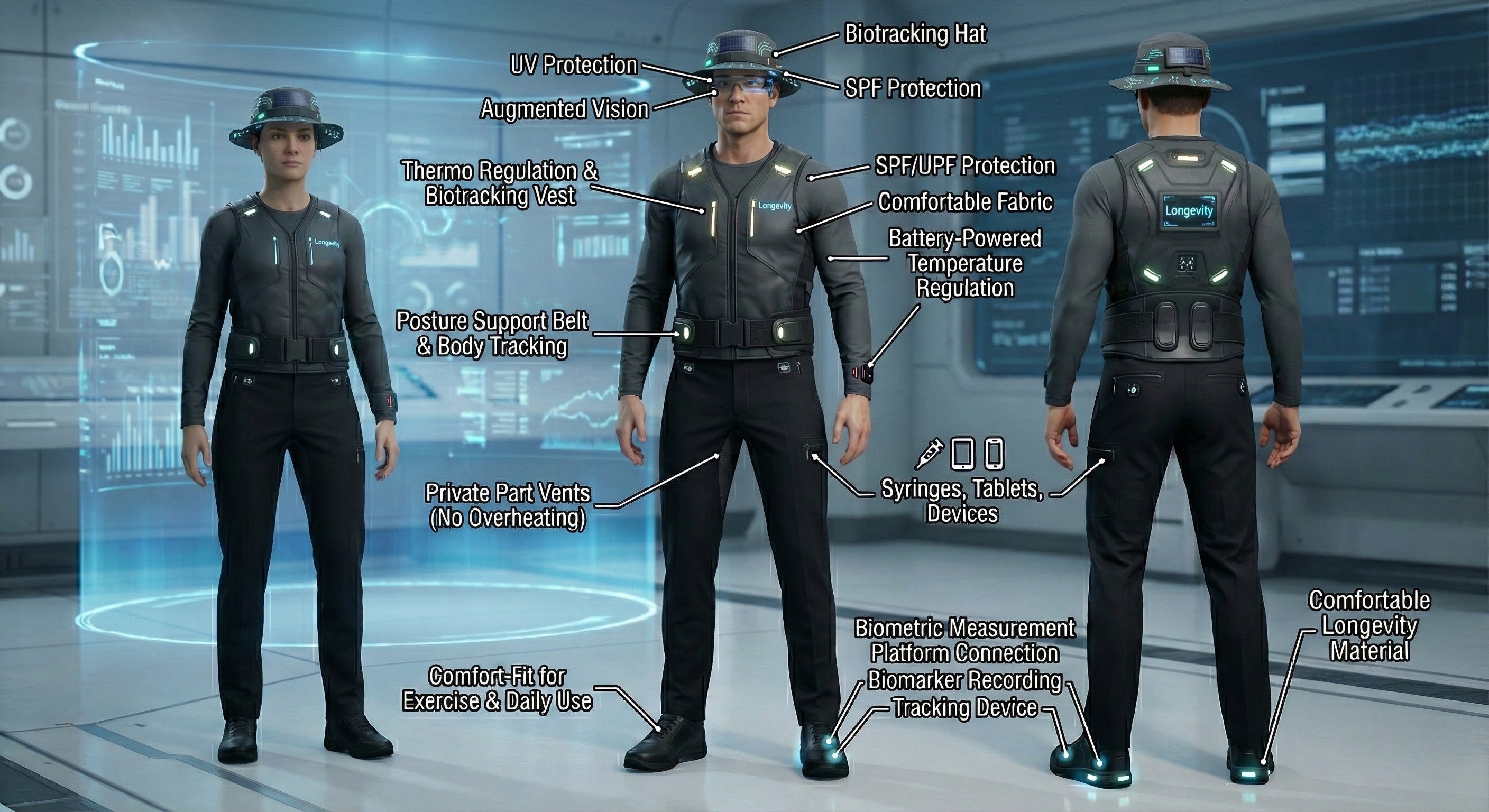
About three weeks ago, I walked the streets of Milan—the undisputed capital of global fashion—with a high-level business delegation from Hong Kong, the undisputed capital of longevity.
The contrast was visceral. Milan is a monument to aesthetics, history, and La Dolce Vita. But Hong Kong is a monument to biological success. The life expectancy in Hong Kong is 85.77 years— the highest in the world.
I consider this the ultimate Key Performance Indicator (KPI) of a civilization. Unlike wealth, where the delta between the rich and the poor can be 1,000x, biological time is the great equalizer. The richest tycoon cannot buy a 3x multiplier on their lifespan compared to the average citizen. Everyone is confined to a relatively narrow range.
That is why life expectancy—not GDP—is the only metric that truly matters. If you want to criticize Hong Kong, simply compare its life expectancy to where you live, and fix your own house first.
But walking through Italy, I realized something troubling. I pulled out my phone and searched for “longevity fashion.” Do you know what came up?
Sustainability.
Thousands of articles about organic cotton, “slow fashion,” and biodegradable fabrics.
This is a massive category error.
We are draping our bodies in passive, rotting cloth while we use generative AI to discover drugs that rewrite biology. We are applying 21st-century intelligence to reprogram aging—and still wearing 19th-century textiles optimized for tradition, not physiology.
Longevity Fashion is not about the survival of the garment. It is about the survival of the wearer.
Clothing must cease to be a covering and become an exosomatic organ—a second skin engineered to extend healthspan. And if that sounds extreme, remember: we already live this way.
Your phone is an exosomatic brain.
Your car is an exosomatic leg.
Your home is an exosomatic immune system (temperature, filtration, safety).
Your clothes are overdue for an upgrade.
So while walking in Milan, I started thinking about what can we do for longevity fashion and made a few notes. Below are my Twelve Commandments of Longevity Couture.
The Twelve Commandments of Longevity Couture
Do Not Accelerate Aging (Primum Non Nocere; the end of the “natural” fallacy)
The Exposome Shield (UV, pollution, pathogens, noise, light)
Locomotion Security (Footwear, traction, fall prevention)
Biomechanical Support (The soft exoskeleton; posture and load distribution)
Hemodynamic Optimization (Graduated compression as daily infrastructure)
Thermoregulatory Homeostasis (Heat, cold, and fertility-aware design)
Gym-Ready by Default (Zero friction movement; clothing that enables training)
The Logistics of Longevity (Pharma-couture; hydration, nutrition, tools)
Continuous Biomarker Monitoring (Your clothes becomes the sensor)
Youthful Signaling & Biofeedback (Stress reduction, confidence loops, cognition)
Circular Durability & Upgradeability (Long-lasting hypoallergenic materials; modular everything)
Augment & Correct (The exosuit endgame; soft robotics as clothing)
1. Do Not Accelerate Aging
The end of the “natural” fallacy.
The first principle is not aesthetic. It is medical. Stop worshiping “natural.” Nature is not a wellness brand. Nature wants you to reproduce and decompose. Thermodynamically speaking, nature wants you to just decompose.
We have a romanticized attachment to certain fibers because they predate modern chemistry. But longevity is not achieved through nostalgia. It is achieved through control—control of exposure, control of moisture, control of friction, control of microbial load, control of temperature.
Here is the uncomfortable truth: cotton is hydrophilic. It absorbs moisture, holds sweat, slows evaporation, and becomes a comfortable habitat for odor and microbial growth in exactly the conditions modern life produces (commuting, crowded spaces, intermittent exercise, long sitting, travel). It also degrades, stretches, and loses structure. That is not inherently “evil.” It is simply a poor substrate for longevity-grade performance.
The Fix: Engineered, carbon-derived synthetics—done correctly.
The Platform: High-grade polyester, polyamide, and elastomers (Spandex/Lycra) are not compromises. They are the platform. They can be:
Biologically Quiet: Non-itch, non-sensitizing when properly finished.
Fast-Drying: Reducing the time moisture stays near skin (bacteriostatic via thermodynamics).
Structurally Stable: Keeping shape and support for years.
Durable: Less replacement, less laundering burden.
What can be built now: A “Biological Inertness Standard” for longevity garments. We need zonal fabrics with hydrophobic outer surfaces and capillary channels that move sweat away from the skin. We need antimicrobial reinforcement in high-humidity zones paired with ventilation. Longevity fashion begins with a simple rule: the default garment must not become a wet ecosystem.
2. The Exposome Shield
Radiation, pollution, pathogens, noise, and light.
Aging does not happen only inside your cells. It happens at the interface between you and your environment. We treat UV protection like a beach accessory and air filtration like emergency gear. That framing is obsolete. Your body experiences continuous environmental load.
The Fix: Clothing becomes your portable environment.
What can be built now:
UPF 50+ by default in outer layers and commuter wear—without overheating.
Discreet filtration integration: Collars/hoods designed to support masks or filters when needed.
Noise protection: Hoods and headwear that reduce harsh urban sound to lower cortisol, without cutting you off from situational awareness.
Sunscreen is chemistry you apply. Longevity fashion is physics you wear.
3. Locomotion Security
Footwear and fall prevention as longevity infrastructure.
If you want a long life, you must remain mobile. Falls are not a minor inconvenience; they are one of the most catastrophic failure modes of aging. The tragedy is that most falls are not “fate.” They are engineering failures: unstable shoes, poor traction, inadequate proprioceptive feedback.
The Fix: Treat footwear as medical equipment in disguise.
What can be built now: A longevity footwear standard featuring a stable base, high traction, shock absorption, and a toe box that respects anatomy. Comfort must hold for 10,000 steps, not 10 minutes. Longevity fashion that ignores footwear is like longevity medicine that ignores sleep. It is incomplete.
4. Biomechanical Support
The soft exoskeleton: posture and load distribution.
Gravity charges compound interest. Poor posture is not only cosmetic; it alters breathing mechanics, increases strain, contributes to chronic pain, and quietly reduces movement.1 Pain reduces activity. Reduced activity accelerates decline.
The Fix: Garments that act as scaffolding—subtle, supportive, constant.
What can be built now: Tension mapping using high-tensile elastomer panels to guide alignment without restricting movement. Distributed load systems (jackets, bags) that stop punishing the neck and shoulders. Think of it as “quiet biomechanics.” Not a brace. Not medical equipment. Just better engineering.
5. Hemodynamic Optimization
Graduated compression as daily infrastructure.
Your circulatory system fights gravity all day. Sitting for long periods—work, flights, commutes—creates predictable problems: swelling, fatigue, and long-term vascular strain.2 Compression has been trapped in the “medical beige” category. That is a cultural mistake.
The Fix: Graduated compression built invisibly into trousers, sleeves, and socks using elastomer blends designed to maintain compression across thousands of wear cycles. If movement is longevity’s engine, circulation is the oil.
6. Thermoregulatory Homeostasis
Heat, cold, and fertility-aware design.
Temperature is a master variable. Your body wastes enormous energy maintaining homeostasis. Overheating increases strain; chronic cold increases discomfort and reduces movement. There is also an ignored subtopic: fertility. Overheating sensitive zones is not “comfort.” It is a design error.
What can be built now: Dynamic ventilation placed where heat actually accumulates (not decorative mesh). Pants engineered for airflow and heat dissipation (Venturi vents). Lightweight heating for extremities in cold environments to maintain comfort without bulky insulation. Thermoregulation is not fashion. It is physiology.
7. Gym-Ready by Default
Zero friction movement.
If you must change clothes to move, you’ve created resistance to longevity. The modern environment pushes you into sedentary behavior. Longevity fashion must invert the default: the wardrobe should make movement frictionless.
What can be built now: Formal silhouettes that stretch, recover, and breathe. Abrasion resistance in high-wear zones so you can actually move without destroying the garment. Sweat management as a first-order KPI (dry time, not just “wicking” marketing). The goal is not “athleisure everywhere.” The goal is movement compatibility everywhere.
8. The Logistics of Longevity
Pharma-couture, hydration, nutrition, and tools.
A serious longevity protocol requires tools: supplements, medications, glucose tabs, insulin pens, inhalers, electrolytes, devices, hydration. The current fashion industry pretends this reality does not exist. So people improvise with bulky bags or noncompliance.
What can be built now: Discreet, secure compartments designed for real use (accessible, washable, anti-loss). Temperature-aware micro-pockets for sensitive items. This is not “cargo pants.” This is systems design.
9. Continuous Biomarker Monitoring
The shirt becomes the sensor.
The annual checkup is an outdated interface. Your biology is continuous. Your monitoring should be continuous. The watch was a start, but wrist sensors are an ergonomically limited interface. Clothing has more surface area and better contact points.
What can be built now: Washable, removable sensor modules integrated into undershirts and bras. Measurement of respiration, heart rate patterns, and posture. The end state is simple: your clothing quietly detects drift and corrects it before you feel it.
10. Youthful Signaling & Biofeedback
Stress reduction, confidence loops, cognition.
Looking young is not vanity. It is a feedback system. Youthful presentation changes how people treat you—and how you treat yourself. It influences confidence, stress levels, and daily behavior.
What can be built now: Cuts that reinforce structure and posture visually and mechanically. Color and contrast that communicate vitality. Gentle biofeedback: reminders to unclench the jaw, lower shoulders, breathe. Longevity fashion should not only protect the body—it should protect the mind from the chronic stressors of modern life.
11. Circular Durability & Upgradeability
The 50-year garment.
This is where sustainability becomes relevant—but only when it is correctly defined. True sustainability is not biodegradability. True sustainability is durability plus circularity.
A high-performance synthetic garment that lasts decades is often more sustainable than a “natural” garment that must be replaced repeatedly. Not because it is morally superior, but because it reduces manufacturing demand, laundering burden, and waste.
The Longevity Approach: Make fewer things. Make them better. Make them repairable.
What can be built now: Replaceable components (cuffs, zippers, insoles). Modular electronics that can be removed and upgraded without trashing the garment. Design-for-disassembly so polymer blends don’t become recycling dead ends.
12. Augment & Correct
The exosuit endgame.
This is the final evolution: clothing that does not only protect and measure, but augments. As biological function naturally declines, the second skin should compensate. Not with stigma. Not with bulky devices. With elegant assistance.
What can be built next: Soft assist garments that reduce joint load during walking or lifting. Stability systems that reduce fall risk. Integration with smart eyewear and hearing systems. The vision is not science fiction armor. It is a quiet shell that makes older adults move with confidence.
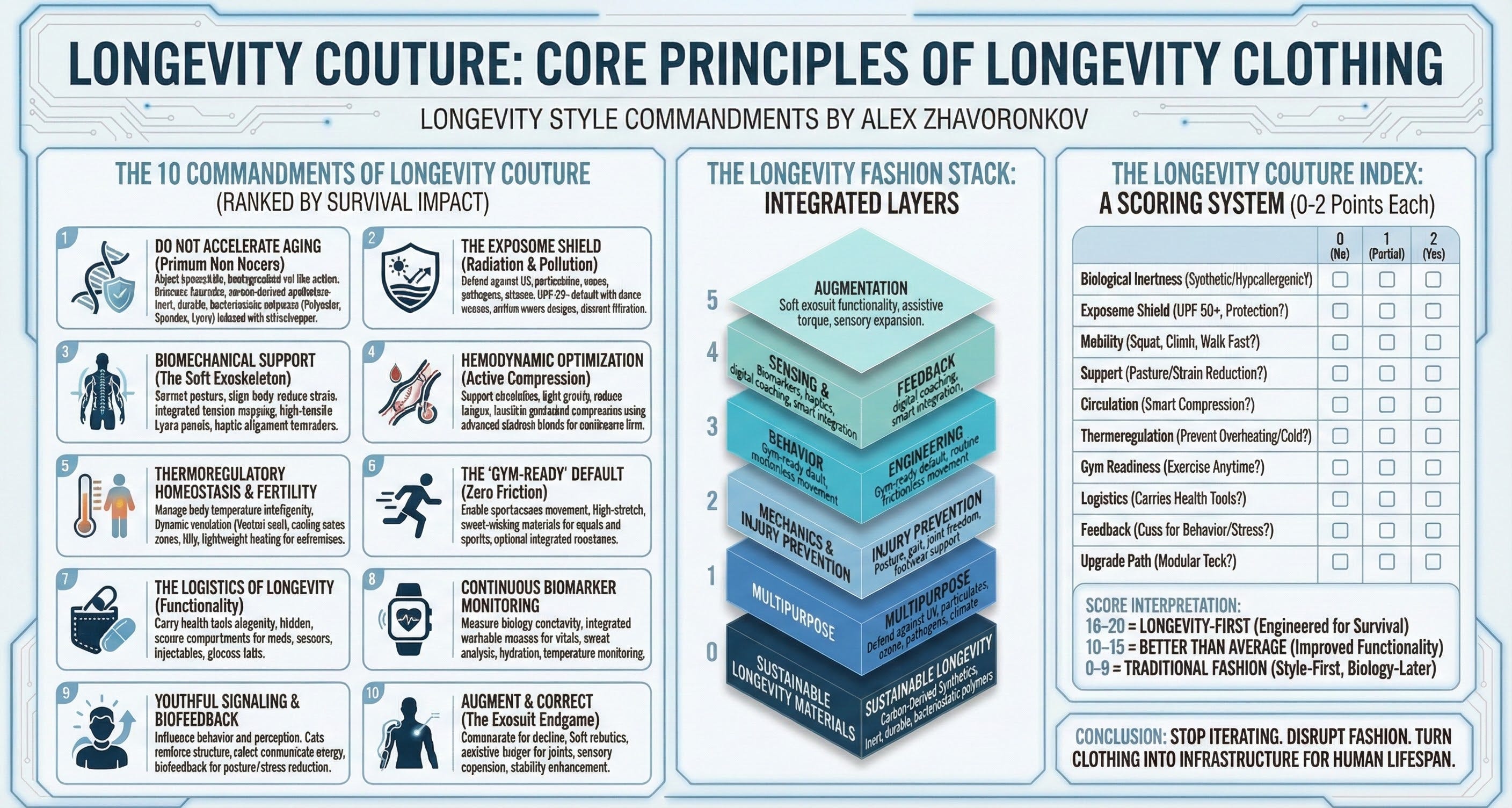
The Longevity Fashion Stack (The OSI Model for Longevity Couture)
Smart clothing exists in fragments. Longevity fashion is the integration layer. We are building a stack:
Layer 0 — Biological Safety (Materials): Carbon-derived, durable, biologically quiet synthetics. Low moisture retention, low odor.
Layer 1 — Exposome Protection: UPF-first designs, pollution and pathogen readiness.
Layer 2 — Mechanics & Injury Prevention: Posture systems, gait support, footwear standards, fall risk reduction.
Layer 3 — Behavior Engineering: Gym-ready default, movement friction removal.
Layer 4 — Sensing & Feedback: Continuous signals, haptic cues, coaching loops.
Layer 5 — Augmentation: Assistive torque, stability, sensory expansion.
Brands typically build one layer at a time. Longevity couture builds the stack.
A Simple Scoring System: The Longevity Couture Index
How do you know if a garment is longevity fashion or just marketing? Score each category 0–2 (0 = no, 1 = partial, 2 = yes). Maximum score: 24.
Biological Inertness — Fast dry, low odor, comfortable on skin, no “chemical feel.”
Exposome Shield — UPF 50+ capability, glare/eye protection options, pollution readiness.
Locomotion Security — Traction, stability, fall-risk reduction (especially footwear).
Mobility — Full range of motion: squat, stairs, long walk.
Support — Posture/load distribution, strain reduction.
Circulation — Integrated compression where appropriate.
Thermoregulation — Heat release, cold management, ventilation in correct zones.
Gym Readiness — You could exercise now without changing.
Logistics — Discreet storage for essentials (health tools, hydration).
Sensing — Meaningful monitoring or readiness for modular sensors.
Biofeedback — Cues that reduce stress and improve behavior.
Upgrade Path — Repairable, modular, circular design.
20–24 = Longevity-First.
14–19 = Competent modern wear.
0–13 = Traditional Fashion (style-first, biology-later).
Conclusion: Stop Iterating
To the designers in Milan and the innovators in Hong Kong: Stop iterating.
We do not need another season of trends. We do not need more “organic” garments that behave like sponges. We do not need sustainability that confuses biodegradability with progress.
We need a fundamental disruption.
Longevity Couture is not just a style. It is a survival strategy.
It is the convergence of biotechnology, ergonomics, sensors, robotics, and advanced materials science into a wearable interface for human health. The future of fashion isn’t about what you wear on the runway.
It’s about what you wear to break the world record for human lifespan.
If you are a designer reading this, start with Commandment #1: stop worshiping “natural,” start engineering “biologically quiet.” Then build the shield. Then build posture. Then build compression. Then augmentation.
Step by step, we turn clothing from decoration into infrastructure. The next fashion revolution will not be seasonal.
It will be biological.
Love this take on longevity fashion. We were it everyday.. we might as well make it functional. ;)
I'd consider spaceship uniform-like look (think Star Trek). The future should look like the future (c)