

I’ve been thinking about a paradox that genuinely baffles me. Pharmaceutical companies take the biggest financial risks of any industry on the planet — a billion dollars and 12-15 years of work on a single molecule that has maybe a 5% chance of making it through clinical trials — all to cure diseases and extend human life. And yet, as Peter Kolchinsky put it in The Great American Drug Deal, pharma is “one of America’s most hated industries.” We largely took for granted that the public would love us for our treatments and cures. They don’t.
This is very frustrating. But this is the nature of the world we operate in.
Think about it. Not tobacco. Not weapons manufacturers. Not alcohol. Not the high fashion. The industry that cured hepatitis C, that turned HIV from a death sentence into a chronic condition, that gave cystic fibrosis patients decades of life they wouldn’t have had — that’s the one people hate because frontier drugs are usually expensive before they go generic. Kolchinsky calls it the “Biotech Social Contract” — companies get a temporary premium on new drugs, that premium funds the next generation of cures, and eventually everything goes generic. It’s the most altruistic business model in capitalism. And the public despises it.
There’s a related phenomenon that I find deeply frustrating. Every single time someone in longevity biotechnology makes any progress or announcement — any at all — the headline writes itself: “billionaires want to live forever.” It’s reflexive. It requires zero thought from the journalist. And it works because it resonates with the socialist majority who find it emotionally satisfying to believe that health is a zero-sum game. That if someone is working on extending life, they must be hoarding it for the rich. It isn’t true. It never was. But that narrative gets clicks, and so it persists, and so the scientists and entrepreneurs doing genuinely difficult work get punished for it in public opinion.
Here’s what nobody wants to hear, and what I’ve been saying at conferences for probably fifteen years: the reality of life extension is extremely dull. There is virtually no drug outside of anti-infectives and vaccines that can extend the healthy productive life of everyone on the planet by simply two years. Two years. That’s the bar, and almost nothing clears it. Maybe we’ll see it with GLP-1 receptor agonists — that’s genuinely exciting, because the metabolic cascade they normalize touches enough aging biology simultaneously that they might actually move the needle at population scale. But historically? There is simply nothing you can possibly do beyond what I call DYMT: Do What Your Mother Told You. Don’t smoke. Exercise. Eat vegetables. Sleep. Don’t drink too much. DYMT already pushes you beyond the population average. It’s free. It’s boring. And it works better than any pill we’ve ever made.
So when people ask me “what’s the secret to longevity?” I want to laugh. There is no secret. DYMT. The real question — the hard question — is whether we can develop therapeutics that give you something beyond DYMT, something that addresses the underlying biology of aging itself. The honest answer is: we’re working on it, it’s incredibly hard, and it will take decades of grinding. Not miracles. Grinding.
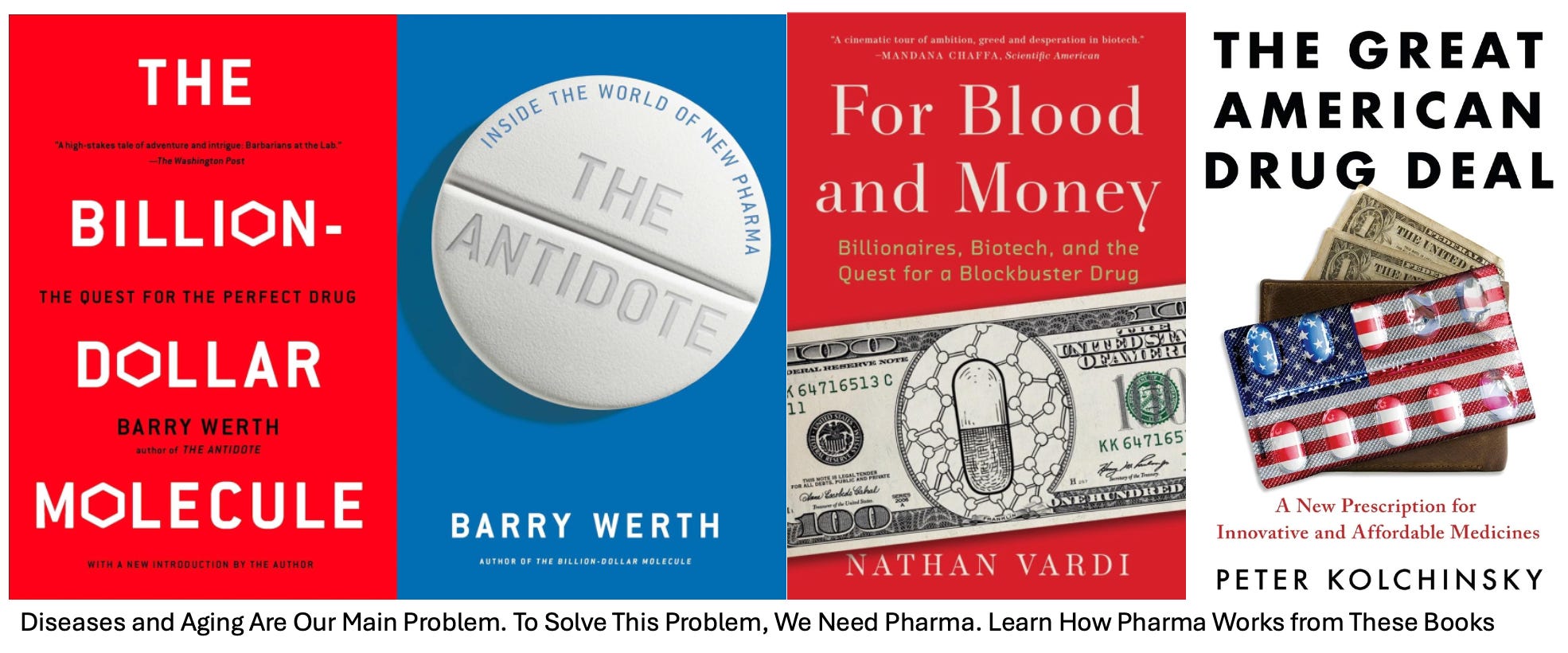
And for anyone who is genuinely interested in understanding how biotechnology companies are built — not the Twitter or TikTok version, the actual version with the terror and the near-death experiences and the years of nothing working — I want to recommend three books that capture this reality better than anything else I’ve read.
The first is The Billion Dollar Molecule by Barry Werth. Published in 1994, it follows Joshua Boger leaving Merck — one of the most comfortable and prestigious positions in pharmaceutical research — to found Vertex Pharmaceuticals and pursue rational drug design from scratch. This was 1989. Most of the industry thought designing drugs atom-by-atom using structural biology was science fiction. Boger bet his career on it anyway. Werth captures the terror of fundraising, the 16-hour days, the fundamental tension between doing good science and keeping the company alive long enough for the science to matter. If you think starting a biotech company is like starting a software company, this book will cure you of that delusion.
The follow-up, The Antidote, also by Werth, came out twenty years later in 2014. It shows what happened next. And what happened is that it took Vertex twenty-five years to build a sustainable pharmaceutical company. Twenty-five years. They had telaprevir for hepatitis C — briefly a $1.5 billion drug, one of the fastest launches in pharma history — and then Gilead came along with sofosbuvir and killed it in two years. Gone. Vertex had to pivot to cystic fibrosis, which finally became the franchise that made the company. The lesson of these two books together is simple and brutal: this is how long it actually takes. Not the 18 months the press release suggests. Decades.
The third is For Blood and Money by Nathan Vardi, published in 2023. This is the story of ibrutinib — the BTK inhibitor that became Imbruvica and changed how we treat blood cancers. Richard Miller acquired it from Celera Genomics for $6.6 million as part of a three-compound package deal. Six point six million dollars. The company developing it, Pharmacyclics, nearly collapsed. Then Bob Duggan came in, doubled down with his personal fortune when rational people would have walked away, and eventually AbbVie bought the whole company for $21 billion. Vardi’s book is essential because it shows the money side — the side that scientists often ignore or find distasteful. Drug development isn’t just science. It’s a financial blood sport where conviction, timing, and tolerance for existential risk determine who survives and who disappears.
These three books together paint the complete picture of how drugs actually get made. And the message is uncomfortable for everyone. For the public: these are not evil people in boardrooms deciding to charge you more. These are people betting their careers and fortunes on molecules that will probably fail. For aspiring biotech entrepreneurs: don’t expect miracles. Expect the grind. Expect to be hated for it.
Some encouragement from the broader public would be useful. Some basic understanding of what this high-stakes game involves. Most of the people in biotechnology are not in it for the money. I know that sounds impossible to believe given the headlines, but it’s true. If you wanted to get rich, there are far easier paths — real estate, software, finance. You go into biotech because you’re obsessed with biology and you think you can make something that helps people. But you need to make massive bets. You need to invest many years of your life to get a single drug approved. And once you get it approved, you know what happens? You do it again. This is what I call the scaling law of AI in pharma. You need to discover a drug to be able to discover a drug. The first one teaches you everything — the infrastructure, the regulatory knowledge, the clinical operations, the CRO relationships. You build all of that with the first program, and then you can deploy it across the next ten.
At Insilico, we are living this right now. We are learning how to scale. Thirty drug candidates developed in the past five years with one discovered in the UAE, which never discovered a drug before. Thirteen in clinical trials. Three in Phase 2. One Phase 2 complete. We launch and learn. We scale. Each program teaches us how to do the next one faster, cheaper, with fewer mistakes. And as we scale, we’re getting into more innovative therapeutics — molecules with dual purpose that target both aging biology and specific diseases simultaneously. We can now perform aging biomarker-augmented clinical studies. That means we’re not just asking “does this treat the disease?” but “does this shift the underlying aging trajectory?” Three years ago that was a conversation topic. Now it’s a protocol we’re running.
I hope that one day there will be a book about one or more of our drugs. About how hard it was to get there, how many times we nearly failed (before Developmental Candidate), how the AI actually helped and where it didn’t, how many years of human life were invested to move a single molecule from a computer screen to a patient. How hard it was to fund this. I think that book would surprise people. It wouldn’t be a story about robots replacing scientists. It would be a story about scientists using every tool available — including AI — and still grinding for years.
But many of the ideas about how to persist, how to scale, how to maintain conviction when everything says quit — those I took from these three fascinating books. Read them. And the next time you see a headline about “billionaires wanting to live forever,” maybe you’ll have a better framework for understanding what’s actually happening in those labs.
Public science communication is one of the most important "non-core" activities in the pharmaceutical industry and in science more broadly.
When the scientific community fails to educate the public about science and its impact and role in human life and modern-day civilizational achievements, all sorts of bad actors fill the void of communication with anti-science theories and all sorts of fear-mongering. That sometimes leads to real and dangerous backlash on things that are crucial for the public prosperity and in edge cases -- even human survival in the long run.
I think we need to celebrate every successful science communications project as much as scientific breakthroughs themselves.
Thanks for the article.
Must read.